The Room That Stops Being Hot
A two-story new build in Southlake. Single HVAC system serving five upstairs bedrooms, and the southwest corner room — the daughter's room — has been four degrees warmer than every other bedroom since the day the family moved in. The thermostat lives in the hallway, the sun pours through the corner windows from noon until sunset, and no amount of fiddling with vents ever solved it. Airzone solves it in a single afternoon. A wireless thermostat in that room, a motorized damper above the ceiling, and a control board that finally lets the system listen to the room that needs the most help.
Up to thirty-two zones per system. Each zone holds its own setpoint. The HVAC plant stays the same — the Carrier, Trane, Lennox, or Daikin you already have — but the air starts arriving where it is needed, when it is needed, in the volume it is needed. The house finally feels even.
How TruDefinition Designs and Installs Airzone
We begin with a load calculation. Room by room, square footage, window orientation, insulation level, occupancy pattern. The zone map falls out of the math, not out of guesswork. Most DFW two-story homes land between six and twelve zones — primary suite, secondary bedrooms grouped or individual, the upstairs game room, the formal living, the office. For estates in Preston Hollow and Vaquero we have designed twenty-plus-zone systems that serve a main house, a guest wing, and a pool house from two HVAC systems with one Airzone brain.
Each zone gets a wireless thermostat — glass-faced, battery-powered, three-color icon set that reads as architecture rather than gadget. A motorized damper installs at each branch of the supply duct, and the Airzone control board commands the dampers and modulates the HVAC equipment via integration with the OEM control board. For Carrier Infinity, Trane XV, Lennox SLP98, and Daikin VRV, the integration is full bidirectional — the Airzone brain talks to the variable-speed compressor and modulates the right way. We get the same room-by-room comfort with a meaningful reduction in run time.
Integration With Savant, HomeKit, and the Rest of the Home
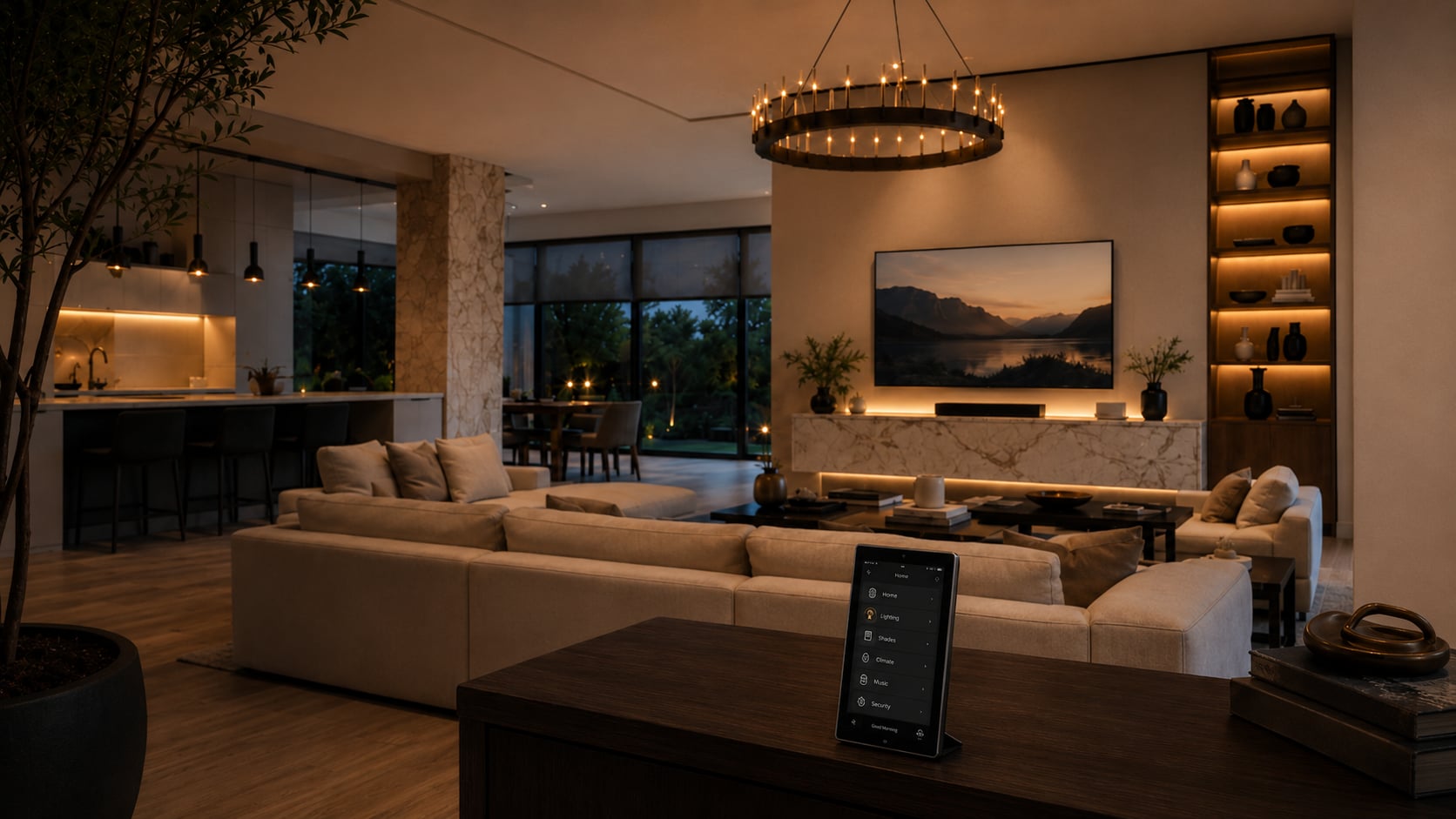
Every Airzone zone lands inside Savant as a first-class thermostat, indistinguishable from a Nest or Ecobee in the app. Scenes call temperature setpoints by zone — a Goodnight scene drops the guest wing to seventy-eight, holds the primary suite at sixty-eight, and pre-cools the kids' rooms at five-thirty AM for school morning. Apple HomeKit integration mirrors every zone for the families that prefer Siri.
Installation runs two to five days depending on zone count and ceiling access. New construction we coordinate during rough-in for the cleanest damper placement and the shortest control runs. Retrofits we plan around attic access — the team is honest about disruption before we start. The hardware carries a two-year manufacturer warranty, the dampers and motors are rated for a fifteen-year service life, and we tune the system seasonally as part of our care plan. Quietly engineered. Quietly comfortable.
The Questions People Actually Ask.
Can Airzone really work with my existing HVAC equipment?
Almost always, yes. Airzone has direct integrations with every major HVAC brand — Carrier, Trane, Lennox, Daikin, Mitsubishi, LG, Goodman, and most others. We confirm compatibility during the site survey by reading the model and serial number of your air handler and condenser. The integration ranges from full bidirectional control on premium variable-speed equipment to standard relay control on single-stage systems. Either way, the zoning works.
How much can zoning actually save on my electric bill?
In DFW, fifteen to twenty-five percent on cooling is typical for a properly zoned two-story home, because the system stops conditioning empty rooms at full setpoint. The savings compound with our Savant Power Monitoring — together you see exactly which zones drive the bill and where the runtime hides. We are happy to model expected savings during the design phase using your historical Oncor usage.
Will adding zones make my HVAC system fail faster?
When designed correctly, no — it usually extends equipment life because the system spends more time in efficient mid-stage operation rather than cycling hard on full call. The risk is undersized return air or oversized zones for the equipment capacity, which is why we run the load calculation and design the smart bypass before we ever cut the ductwork. Done right, zoning is good for the equipment.
Is Airzone better than running multiple separate HVAC systems?
It depends on the home. For two-story homes with one or two HVAC systems already in place, Airzone delivers eighty percent of the comfort of fully separated systems at a fraction of the cost and complexity. For new construction estates over twelve thousand square feet, we often combine separate HVAC systems for wings of the house with Airzone zoning inside each wing. Best of both. We help decide during the design phase, before any ducting is cut.