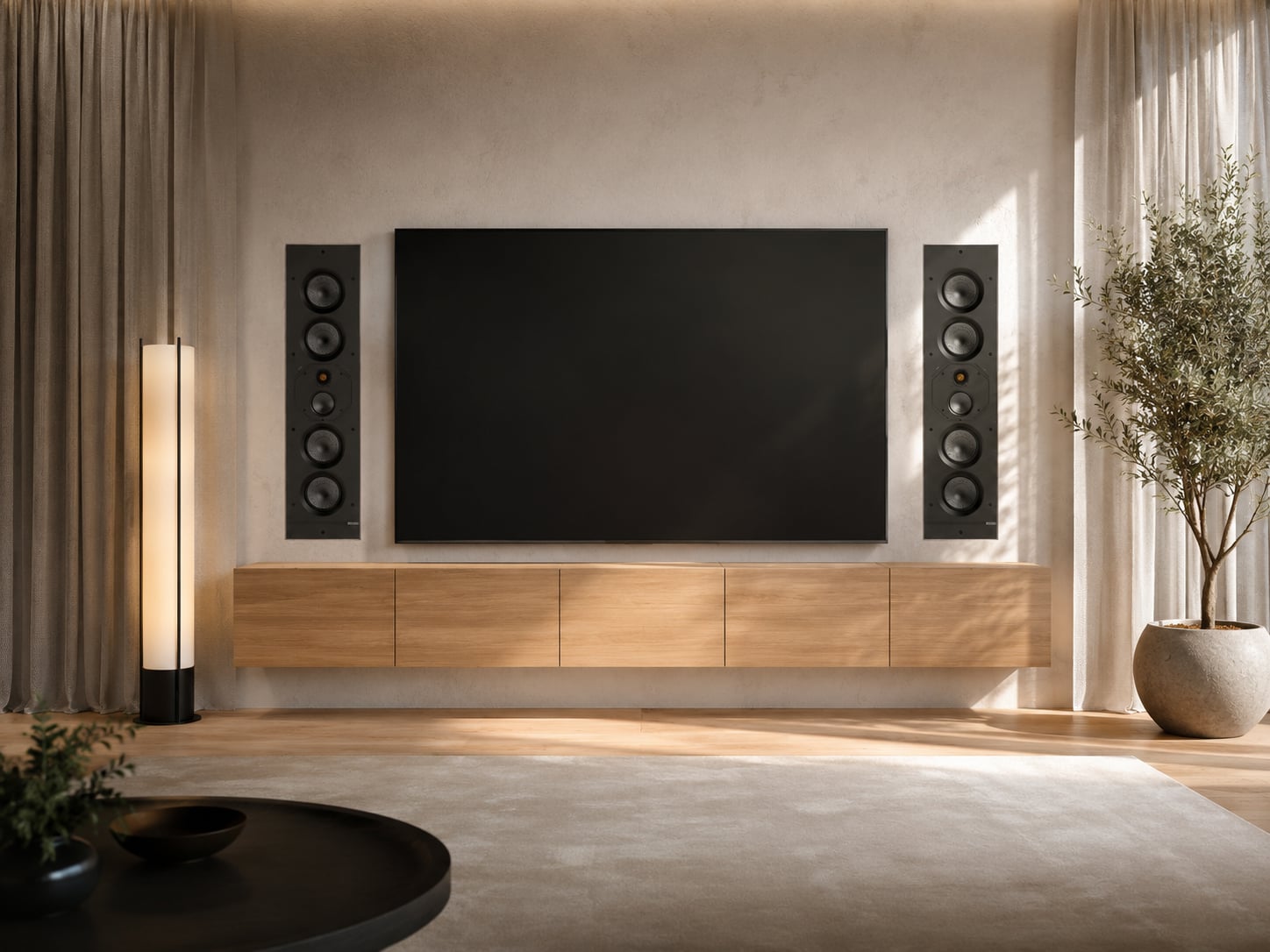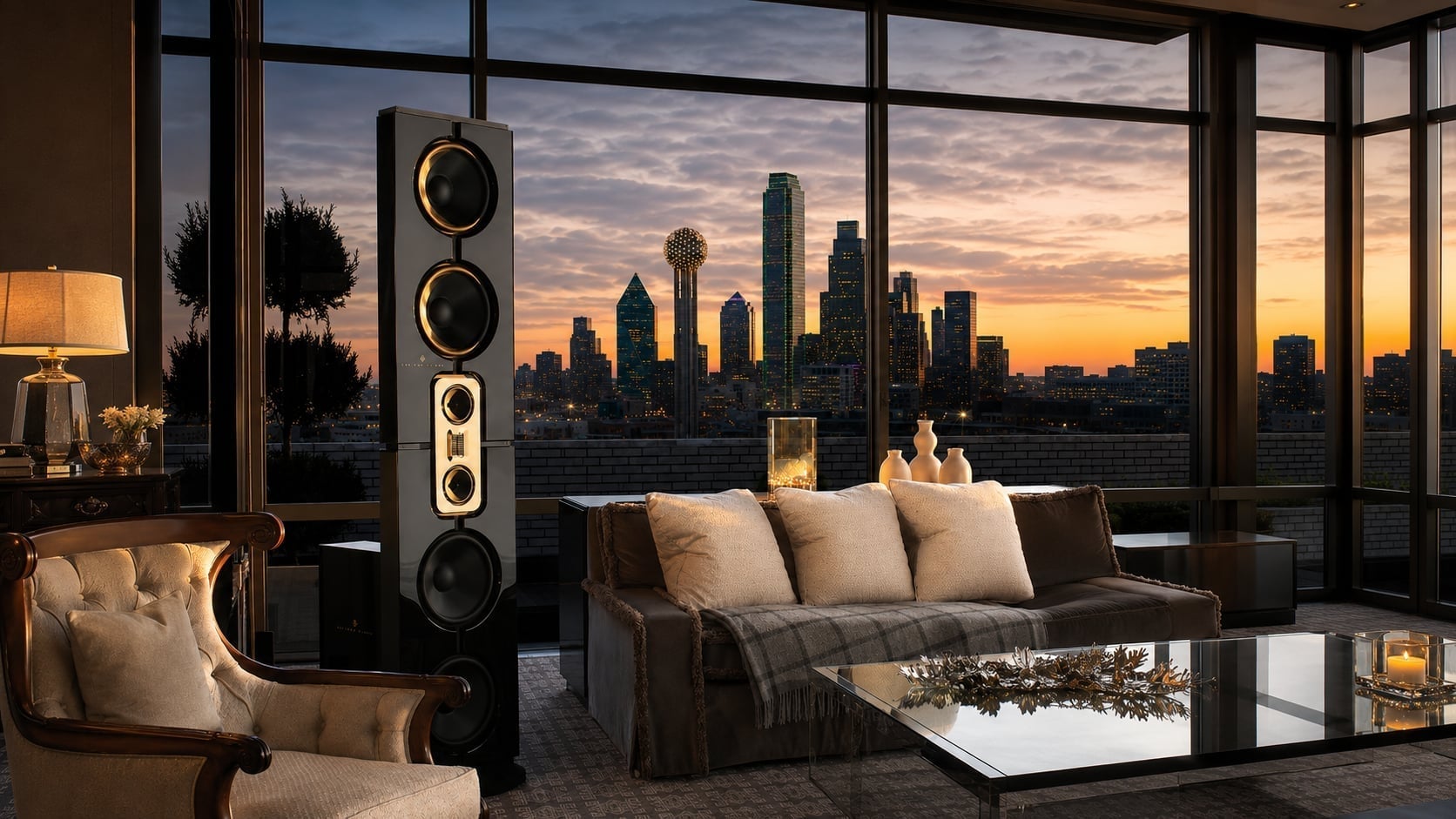
Music in the Walls. None on Display.
Your designer spent six months finding the right plaster, the right lime wash, the right spacing of every sconce. The last thing the room needs is a black box on the credenza. Architectural speakers mount flush with your walls and ceilings — or hide entirely behind drywall and paint — and pour music into the room without a single visible enclosure. We install in-wall, in-ceiling, and fully invisible models from Steinway Lyngdorf, L-Acoustics, and JBL Synthesis in homes across DFW where the interior is not negotiable. These drivers were born for the wall, with back-box enclosures that control resonance and keep sound from drifting into the next room.
They have grown up beautifully. Today's Steinway Lyngdorf Invisible Series and L-Acoustics Director Collection deliver frequency response and dynamics that rival freestanding bookshelves costing far more. The trick is selection, placement, and calibration — three places where the difference between a system that disappears and one that merely plays is professional integration.
Ceiling, Wall, or Truly Invisible
In-ceiling speakers belong in kitchens, baths, hallways, and open-concept rooms where the walls are busy with cabinetry, windows, and art. They aim down into the space and spread sound evenly — perfect for background and easy listening. With the eight-foot ceilings common across DFW, we use models with aimable tweeters that point the highs at your seats instead of the rug.
In-wall speakers carve a tighter stereo image — ideal for media rooms, bedrooms, and offices where you sit in a defined spot. Truly invisible speakers, the ones that hide behind drywall and finish out under joint compound and paint, belong in formal living rooms, dining rooms, and the entry foyers of Highland Park and Preston Hollow homes where nothing — nothing — should announce itself. The panels vibrate the wall surface to make sound, and the latest generation reaches down to 60 Hz without help from a subwoofer.
On the Job Site
Architectural speaker work is happiest during new construction or a real remodel — open walls, easy wire pulls. We hand your builder and electrician detailed drawings during rough-in: stud bays, back-box dimensions, cable pull points. For existing homes, we work the attic and use flexible drill bits so cabling threads in with almost no fuss, and the drywall returns to invisible.
Back-boxes are easy to overlook and easy to get wrong. A properly sized, sealed back-box keeps the speaker from coupling with the wall cavity — which would otherwise turn the bass into something boomy and let sound bleed into the next bedroom. We use Steinway Lyngdorf and L-Acoustics factory back-boxes wherever they live, and we build custom enclosures for non-standard wall assemblies.
Tuning the Room
Every architectural system gets room-by-room calibration with measurement microphones and DSP processing. In-wall and in-ceiling speakers interact with the structure around them, so factory-flat response is never the response you actually hear. We correct for room modes, boundary reinforcement, and the absorption of your particular floor, sofa, drapery, and ceiling.
When we are done, music seems to come from the room itself. Guests will tell you it sounds rich. They will not tell you where it is coming from. That, exactly, is the point.
The Questions People Actually Ask.
Do architectural speakers sound as good as traditional floor-standing speakers?
For distributed music and everyday listening, the best architectural models are right there with floorstanders. For critical two-channel listening, dedicated freestanding speakers still own the bass extension and dynamic headroom. Many of our clients run architectural throughout the home and reserve a dedicated hi-fi room for the chair, the bourbon, and the records.
Can invisible speakers be installed in any wall material?
They are happiest in standard drywall. Plaster, stone, and concrete walls call for specialized mounting, and we evaluate every wall during the consultation so each room gets the right speaker for the surface.
How do you handle retrofitting architectural speakers into existing homes?
Wiring runs through attics, soffits, and wall cavities with flexible drill bits. Speaker cutouts are made with precision templates, and any drywall repair finishes invisible against the surrounding wall. Most retrofits are no more disruptive than hanging art.
Will in-ceiling speakers leak sound into the room above?
Sealed back-box enclosures take care of most of it. For bedrooms or media rooms where quiet matters, we step up to higher-mass back-boxes with extra damping so the isolation rivals a standard insulated wall.
What grille options are available?
Most in-wall and in-ceiling models ship with paintable grilles that take any latex paint to match the ceiling or wall. Steinway Lyngdorf offers square and round options, and certain models wear micro-perforated metal grilles for a more refined look.