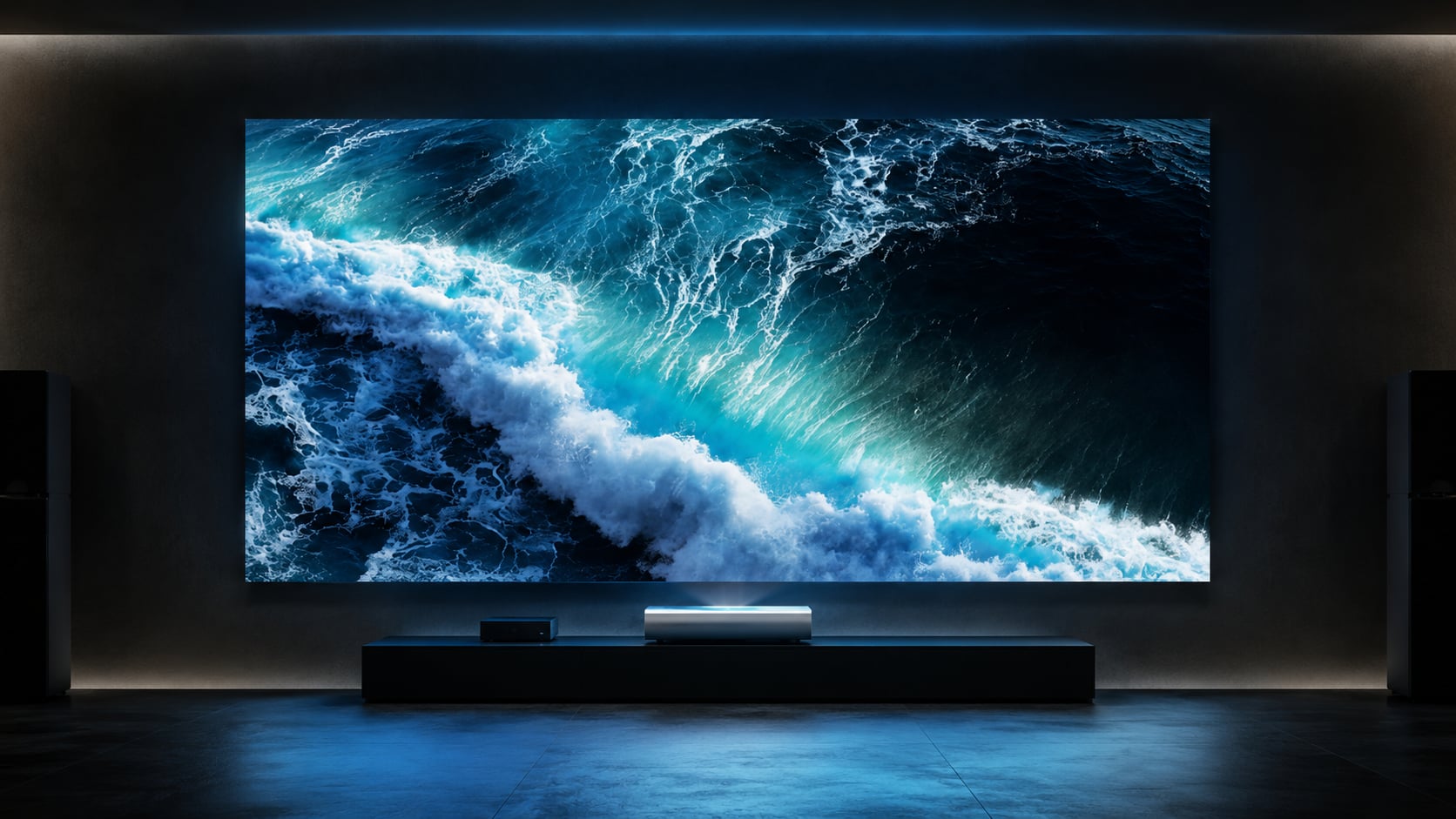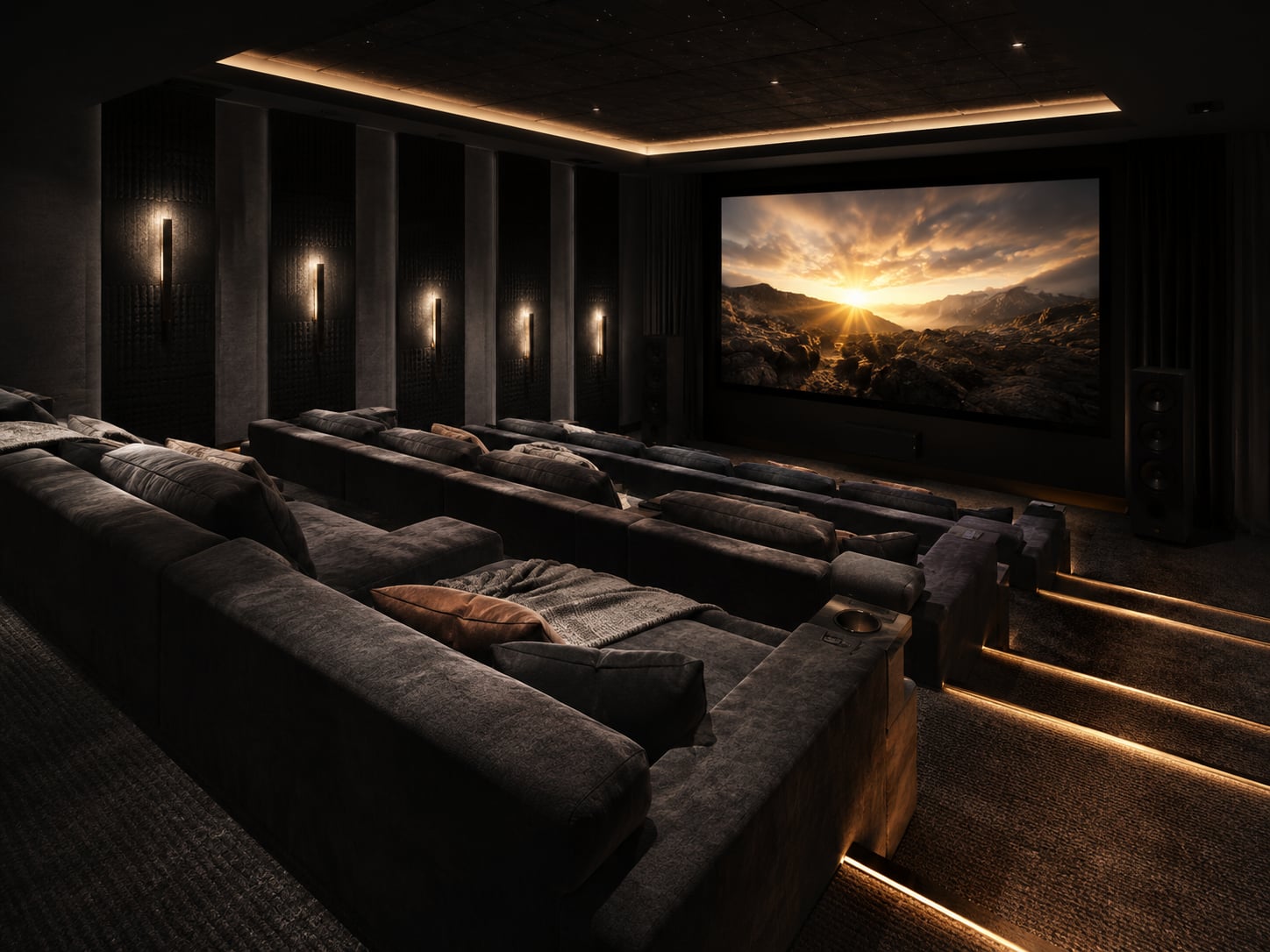
Why Laser Replaced the Lamp
Lamp projectors asked for a new bulb every 2,000 to 4,000 hours, $200 to $500 each, with a slow brightness fade in between. Laser changed all of that. 20,000 to 30,000 hours of rated life — over fifteen years of regular nights — with no lamp swap, no slow dim, no waiting for the engine to warm. Full brightness in a moment. Color that holds. A light source you can forget about.
For DFW homeowners stepping into projection, laser is the answer. Every projector we install at TruDefinition runs laser — from the Epson LS12000 at the entry through the Sony VPL-XW7000ES in the middle to the Barco Njord and Sony GTZ380 at the summit. The old trade-off between lamp convenience and image quality is over. Laser delivers both.
Sony, Epson, Barco — Choosing Your Engine
Sony's SXRD line — the VPL-XW5000ES and VPL-XW7000ES — runs native 4K silicon panels with laser phosphor illumination. The XW7000ES gives you 3,200 lumens, an advanced iris for deep blacks, and Sony's Reality Creation upscaling, which brings 1080p content remarkably close to native 4K. Out of the box, the color is honest. The integration is clean.
Epson's D-ILA projectors — the DLA-NZ7, NZ8, and the flagship NZ9 — are loved for their native contrast. The NZ9 passes 100,000:1 with no dynamic iris in play. Epson's 8K e-shift quadruples the perceived resolution of native 4K, producing a screen with extraordinary fine detail at 150 inches and beyond. For pure picture fidelity in a light-controlled room, this is the reference.
Barco Residential — the Bragi and Njord series — is for the dream room. The Njord delivers up to 38,000 lumens with three-chip laser DLP and true 4K, supporting 200-inch screens with no compromise on brightness or contrast. These are the same engines you find in high-end commercial cinemas, adapted for the home.
Screen and Room, Tuned to DFW
The projector is half the picture. The screen is the rest. For dedicated rooms we specify TruDefinition StudioTek 130 G4 or TruDefinition Zero Edge Pro, with gain values matched to your projector and your viewing angle. Acoustically transparent screens let sound fire through from the speakers behind, so dialogue lands where the actor stands.
DFW homes bring their own conditions. Open-concept living. High ceilings. West-facing windows that paint the wall gold at four in the afternoon. We measure ambient light in your specific room at multiple points in the day before recommending a brightness class. It is a small, often-skipped step that prevents the kind of regret no calibration can fix.
Cleanly Installed. Carefully Calibrated.
Mounting a projector is a precision job. We calculate exact throw, lens shift, and mounting height for your screen size, then set the projector on a dedicated ceiling mount with vibration isolation. Power and signal disappear into the ceiling cavity or run through conduit. For long pulls between the projector and the rack, we use fiber-optic HDMI rated for 8K/48Gbps so nothing falls off across the distance.
After install, our ISF-trained calibrators bring the room to reference. Murideo Seven pattern generator. X-Rite i1Display Pro Plus colorimeter. Portrait Displays CalMAN software. We tune to BT.709 for SDR and BT.2020/DCI-P3 for HDR — grayscale, color gamut, gamma, EOTF, dynamic tone mapping. The calibration is saved to the projector's memories, ready any time you want it.
The Questions People Actually Ask.
How long do laser projectors last?
Laser engines are rated for 20,000 to 30,000 hours — roughly 15 to 20 years of regular nights at four hours a day. Unlike lamps, lasers do not burn out suddenly. They fade gently across their life and stay watchable far longer than any lamp ever did.
Is 8K projection worth the investment right now?
Native 8K content is still rare in 2026. That said, Epson's 8K e-shift upscales 4K content with visible improvement on screens 130 inches and larger. If you are building a reference theater and plan to keep the engine for ten years or more, e-shift earns its place today and positions you well for tomorrow.
Can I use a laser projector in a room with some ambient light?
Yes — with caveats. A 3,000+ lumen laser engine paired with an ALR screen can hold a watchable image in moderate ambient light. For the picture to truly shine, we still recommend light control — motorized blackout shades on the windows at minimum. We design for both light-controlled and ambient-light rooms.
What screen size should I choose for my room?
Screen size follows throw distance, seating distance, and room dimensions. For most DFW theaters with seating 12 to 16 feet from the screen, 120 to 150 inches diagonally is the sweet spot. THX recommends a 36-degree viewing angle from the primary seat. We calculate the right size during the design conversation.