The Treatment the Studios Use
GIK Acoustics built its reputation in professional studios — the mastering rooms in Nashville, the tracking rooms in Brooklyn, the broadcast facilities in Los Angeles. The same panels show up in the reference theaters of homeowners who care more about how the room measures than how the room photographs. Honest engineering, transparent specifications, and a price-to-performance ratio that has quietly made GIK the default for serious listening rooms across the country.
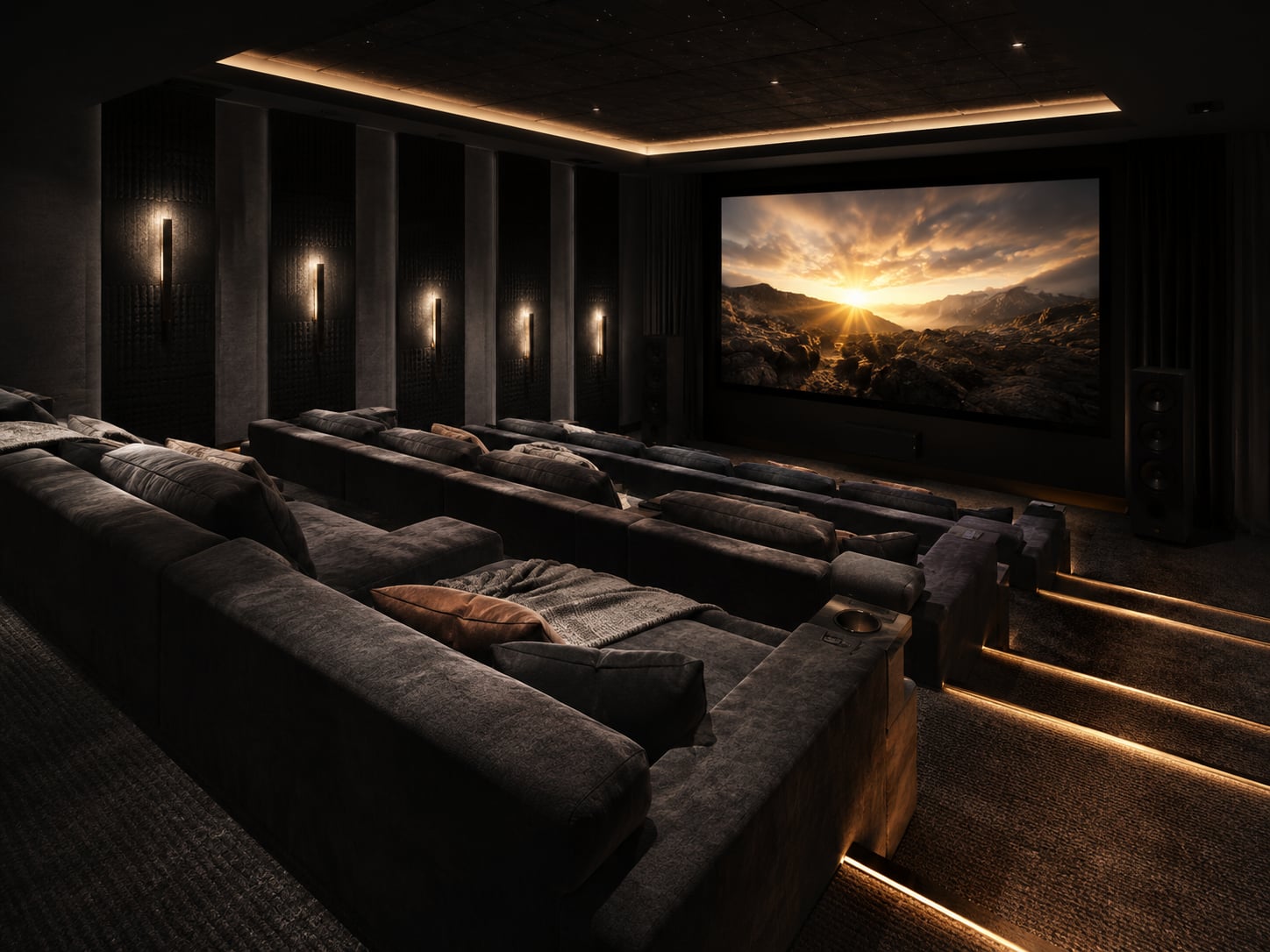
For DFW homeowners building a dedicated cinema or a critical listening room, GIK is often the right answer — particularly when the design brief is invisible performance. The panels wrap in any fabric color the client chooses, mount cleanly to walls and ceilings, and disappear into a finished room that nobody can quite explain why it sounds so right.
The GIK Panels We Specify
The 242 Acoustic Panel is the workhorse broadband absorber — two-inch fiberglass core, fabric-wrapped, effective from about 200Hz upward. We deploy them at first-reflection points on side walls and ceilings. The 244 is the thicker four-inch version that extends absorption down into the lower midrange — useful in rooms with persistent muddiness around speech frequencies. The Soffit Trap and Tri-Trap are corner-loaded bass traps that handle the low-frequency modes that build up in room corners.
For diffusion, the Alpha series brings a modulated scattering pattern in either pure diffuser or absorber-diffuser hybrid configurations. We specify them on the rear wall and rear ceiling of theaters to break up the backwall return without killing the natural ambience the surround speakers need to do their work. The whole catalog is modular, transparent in its specifications, and engineered for actual measurement targets — not marketing claims.
Placement, Measurement, the Quiet Result
Every GIK install begins the same way as Vicoustic — measurement at the primary listening position with a calibrated microphone, modeling of the room's modal behavior, and a treatment plan that targets specific frequencies at specific locations. First-reflection absorbers at the side walls and ceiling. Bass traps in all four corners (and sometimes the wall-ceiling junctions in modal trouble spots). Diffusion on the rear wall.
The panels mount with GIK's impaling clips or with French cleats that hold them flush to the wall and allow easy removal for service or repainting. We coordinate fabric color with the room's design — matching wall paint, accenting in a contrasting tone, or wrapping in a print or pattern when the room calls for it. After installation, we re-measure and tune the processor's room correction to the new acoustic environment. The decay times come in. The bass nodes flatten. The room finally sounds the way the engineer intended.
The Questions People Actually Ask.
Is GIK as good as Vicoustic?
For pure acoustic performance, GIK measures right alongside Vicoustic and any other studio-grade brand. The difference is finish options. Vicoustic offers wood veneers, fluted surfaces, and architectural diffusers. GIK offers fabric wrapping in any color or pattern — exceptional performance, slightly less visual range. For a theater where the panels live behind acoustically transparent fabric walls or are intended to read as fabric panels, GIK is often the better value.
How many panels does my room need?
A typical 18 by 24-foot dedicated theater wants ten to sixteen broadband absorbers, four corner bass traps, and two to four diffuser panels on the rear wall. Smaller media rooms need less. The exact count comes out of the measurement and modeling phase — we never specify by rule of thumb.
Can GIK panels be hidden behind fabric walls?
Yes — beautifully. For dedicated theaters with fabric-wrapped wall systems, GIK panels mount directly to the wall behind the fabric, completely hidden from view. The fabric is acoustically transparent so the panels do their work without ever showing themselves. This is our most common installation method for high-end DFW theaters.
What is the difference between absorption and bass trapping?
Absorption tames mid and high-frequency reflections that cause flutter echo and harshness — typically using thinner panels at first-reflection points. Bass trapping controls low-frequency modal buildup in room corners using thicker, denser panels with air gaps that absorb the long wavelengths of bass. Most rooms need both, and the balance depends on the room's specific modal behavior.