Why Clean Power Decides Everything
A reference theater costs what it costs because of what you cannot see — the calibration, the room treatment, the cabling, and the power. The AC coming out of the wall in a DFW home is not what your projector and processor were engineered to receive. Oncor delivers a wave that fluctuates between 110 and 125 volts depending on the time of day, riddled with high-frequency noise from every motor, dimmer, and switch-mode supply in the neighborhood, and punctuated by surges from summer storms that arrive without warning.
Torus Power solves this with the oldest and most proven piece of engineering in the audio world — the toroidal isolation transformer. A solid copper-wound torus that magnetically transfers power from the input to the output, completely isolating your equipment from the AC line. No noise crosses. No surges pass through. The voltage is stabilized to within a fraction of a percent. The result is what the engineers heard in the mastering room.
The Torus Line We Carry
The AVR series is the line we specify most often — integrated automatic voltage regulation that holds output voltage at 120V regardless of input fluctuation between 90V and 140V. Available from 5kVA for a media room rack up to 30kVA for a fully built dedicated cinema. Wall-mount or rack-mount, plug-in or hardwired depending on the install. We size the transformer to the total draw of every connected component with a 30 percent margin for future expansion.
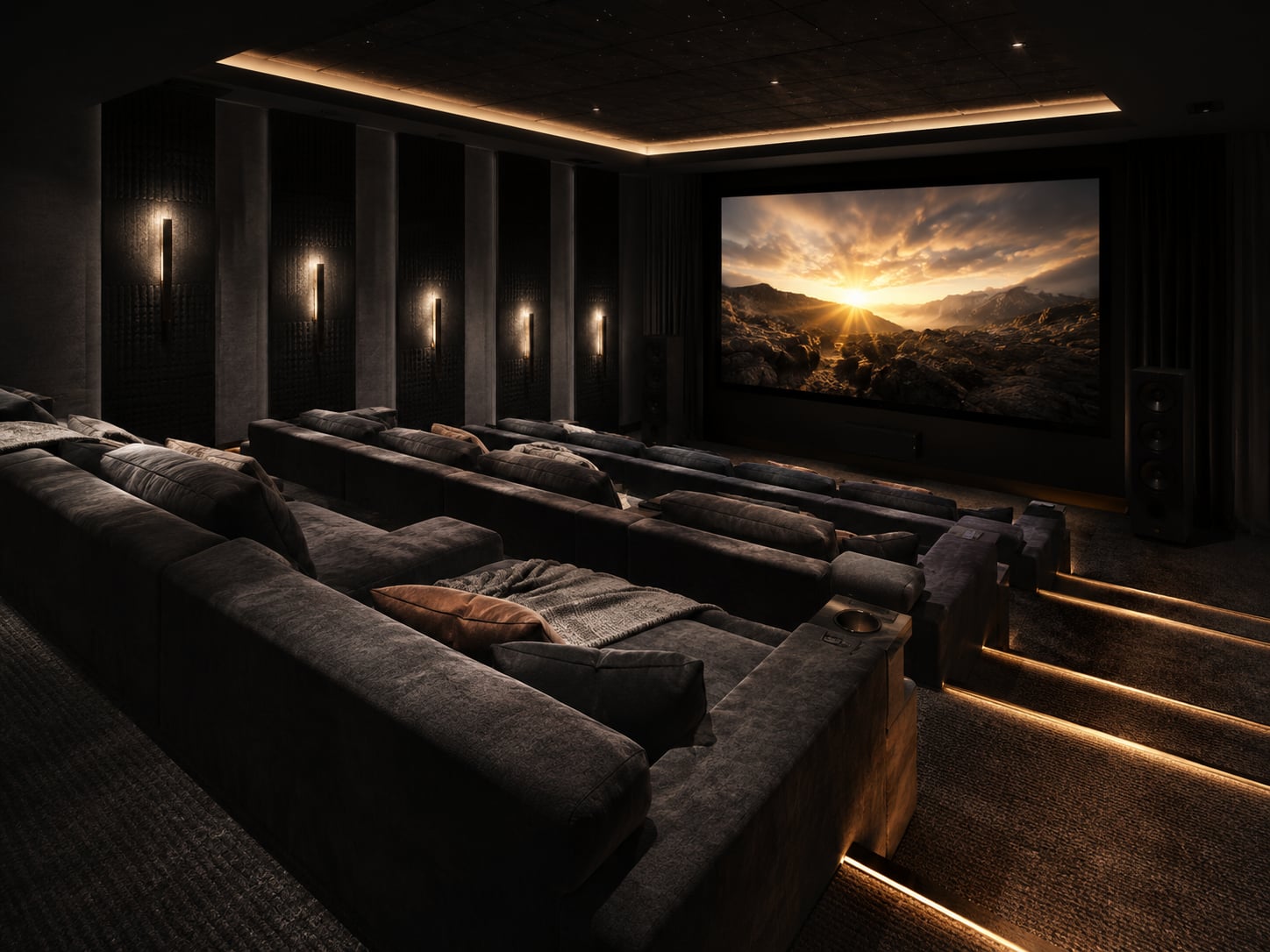
For the largest installations — dedicated cinemas with a Barco engine, a JBL Synthesis processor chain, and ten or more channels of amplification — we specify the RM series in 50kVA to 100kVA configurations, hardwired to a dedicated sub-panel and feeding the entire theater. At that scale, the transformer mounts in a utility space and the theater feeds from it through a dedicated panel. Everything in the room runs on clean, isolated, regulated power. The difference is audible from the first frame.
Installation, Sizing, and the Load Calculation
A Torus install begins with a load calculation. We total the current draw of every connected component at peak operation — projector, processor, amplifiers, source equipment, lighting, motorized screen — and select a transformer rated at least 30 percent above the peak. Undersized transformers run hot and limit dynamic headroom. We never specify to the edge.
The installation itself is straightforward for plug-in units — the transformer mounts in the rack or in an adjacent equipment closet, equipment plugs into the conditioned outlets, and the input plugs into a dedicated 20A or 30A circuit. Hardwired units require a licensed electrician to wire from the breaker panel through conduit to the transformer's input terminals, with output feeding either a dedicated sub-panel or directly to the equipment outlets. We coordinate the electrical work, the permitting, and the inspection so everything passes Dallas or Tarrant County code without a second glance.
The Questions People Actually Ask.
Will I actually hear the difference?
In a reference-grade system — yes, immediately. The noise floor drops measurably, dynamic peaks deliver more cleanly, and the high frequencies open up because the equipment is no longer struggling against line noise. In a more modest system, the difference is subtler but still real — and the surge protection alone justifies the install in a DFW home subject to summer storm activity.
Why a transformer instead of a power conditioner?
Power conditioners filter noise but do not isolate the equipment from the line. A surge or fault on the AC line still passes through to varying degrees. A toroidal isolation transformer creates a true galvanic break between the input and the output — no electrical connection, only magnetic. Surges, ground loops, and high-frequency noise simply cannot cross the transformer.
How large of a transformer do I need?
A media room rack with a projector, processor, and a multi-channel amplifier typically draws 1,500 to 3,000 watts at peak — a 5kVA Torus handles it comfortably. A dedicated theater with a Sony or Barco engine, JBL Synthesis processing, and full amplification draws 5,000 to 15,000 watts and wants a 15kVA to 30kVA unit. The largest reference cinemas need 50kVA or more. We size to your equipment list during the design phase.
Can Torus protect the whole home, not just the theater?
Yes. Beyond rack and theater units, Torus builds whole-home isolation transformers that install at the main panel and clean and protect every circuit in the house — lighting, networking, appliances, and AV together. For estates where the entire system deserves the same regulated power, we size a whole-home Torus into the electrical design.
Does Torus replace the need for SurgeX or other surge protection?
The Torus transformer provides excellent surge isolation through its magnetic design. For the most demanding installations, we still recommend SurgeX series-mode protection upstream of the Torus for absolute protection against catastrophic events. Together, the two form a complete power protection chain — one galvanic break between your gear and everything noisy on the line.