Treatment That Lives in the Architecture
A reference theater is half engineering and half quiet aesthetics. The room needs to absorb the right frequencies, diffuse the right reflections, and trap the right bass nodes — and it needs to do all of that without looking like a recording studio bolted onto someone's house. Vicoustic is the Portuguese acoustic company that built its reputation on solving both halves of the problem at once. Their panels are precision-engineered absorbers and diffusers wrapped in finishes that read as architecture, not equipment.
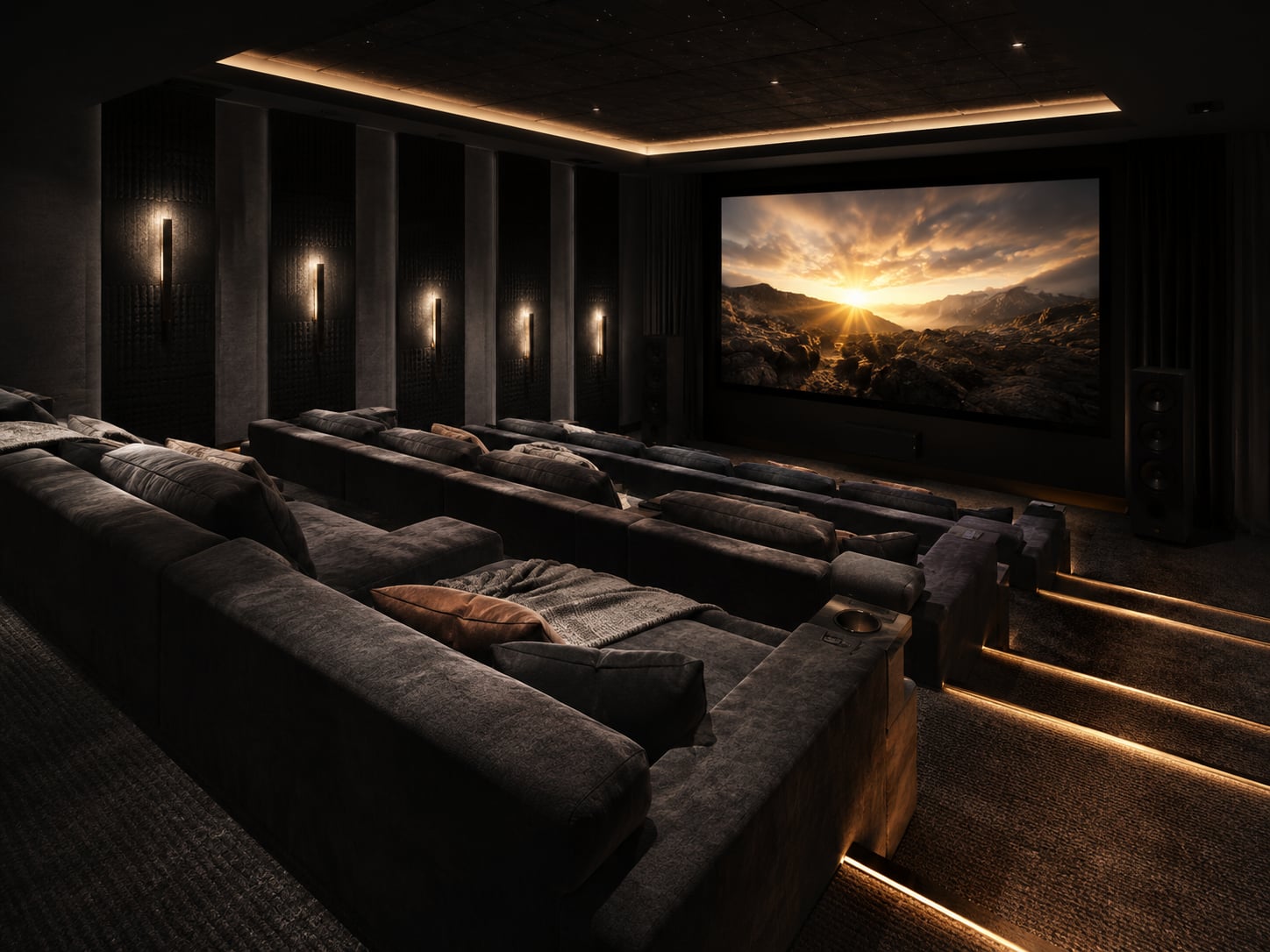
We specify Vicoustic in the rooms where the homeowner wants reference acoustic performance but the design language is contemporary refinement — a Highland Park theater finished in fluted walnut, a Southlake media room with linen-wrapped walls, a Frisco listening room where the chairs face a turntable and a pair of Steinway Lyngdorf monitors. The treatment disappears into the room. The sound does not.
The Vicoustic Catalog We Reach For
The Multifuser series is the diffuser line we specify most often — wood-veneered surfaces with a mathematically optimized scattering pattern that breaks up high-frequency reflections without dulling the upper octaves. Available in natural, walnut, oak, wenge, and custom finishes that match the millwork. The Wavewood line is the broadband absorber-diffuser hybrid, useful on side walls where both functions are needed at once.
For the front wall behind acoustically transparent screens, we specify Cinema Round absorbers — dense foam cores wrapped in acoustically transparent fabric that handles the early reflections off the speakers without robbing energy from the direct sound. For bass control, the Super Bass Extreme series traps low-frequency modes in the corners of the room where they pile up. The system is modular, and every piece is engineered to work alongside the others.
Measurement, Placement, the Finished Room
Every Vicoustic install begins with measurement. We take impulse responses at the primary listening position and several supporting positions with a calibrated microphone, then build a model of the room's modal behavior, decay times, and reflection geometry. The treatment is placed where the math says it belongs — first-reflection points on the side walls and ceiling, modal corners for bass traps, scattering panels on the rear wall to break up the backwall return.
Installation happens after the framing and drywall are finished but before the final millwork or finished wall covering. The panels mount with concealed Z-clips that hold them flush to the wall, with the surrounding millwork built up around them so the finished surface reads continuous. After installation, we re-measure the room, verify the target decay times across the spectrum, and tune the processor's room correction to the new acoustic environment. The result sounds the way a reference room is supposed to sound.
The Questions People Actually Ask.
How does Vicoustic compare to GIK Acoustics?
Both are excellent. GIK Acoustics is studio-proven and offers extraordinary value at a more accessible tier — fabric-wrapped panels in custom colors, broadband absorbers, and bass traps engineered to studio specification. Vicoustic operates at a higher price tier and offers significantly more architectural finish options — wood veneers, fluted surfaces, and integrated diffuser-absorber hybrids. We specify Vicoustic when the design brief calls for the treatment to be visible and beautiful, and GIK when the priority is invisible performance.
Do I need both absorption and diffusion?
In a well-designed theater, yes. Absorption controls early reflections and tames the room's reverberation time. Diffusion breaks up the strong specular reflections at the rear of the room without killing the natural ambience. A room with only absorption sounds dead. A room with only diffusion sounds chaotic. The balance is what makes a reference room.
Can Vicoustic match my existing millwork?
Yes. Vicoustic offers a range of standard wood veneers and will produce custom finishes on order to match your specified millwork. We coordinate samples between Vicoustic and your millworker so the panel finishes integrate cleanly with the surrounding architecture.
Will acoustic treatment make my room look like a recording studio?
Only if you want it to. Vicoustic specifically engineers their panels to read as architecture — wood-veneered diffusers that look like wall paneling, fabric-wrapped absorbers integrated into millwork bays, ceiling treatments that read as coffered detail. The acoustic performance lives behind a finish that respects the rest of the home.