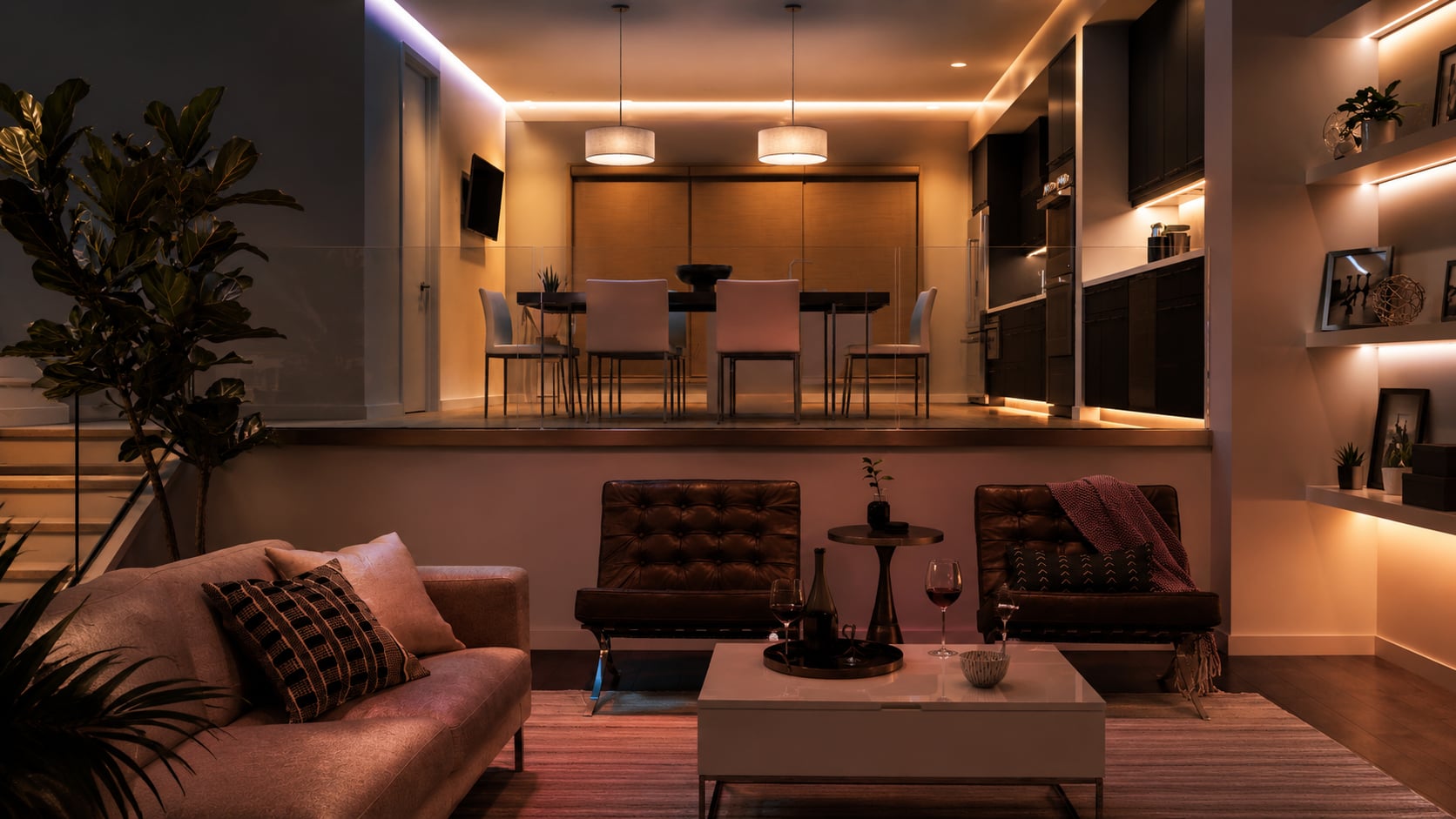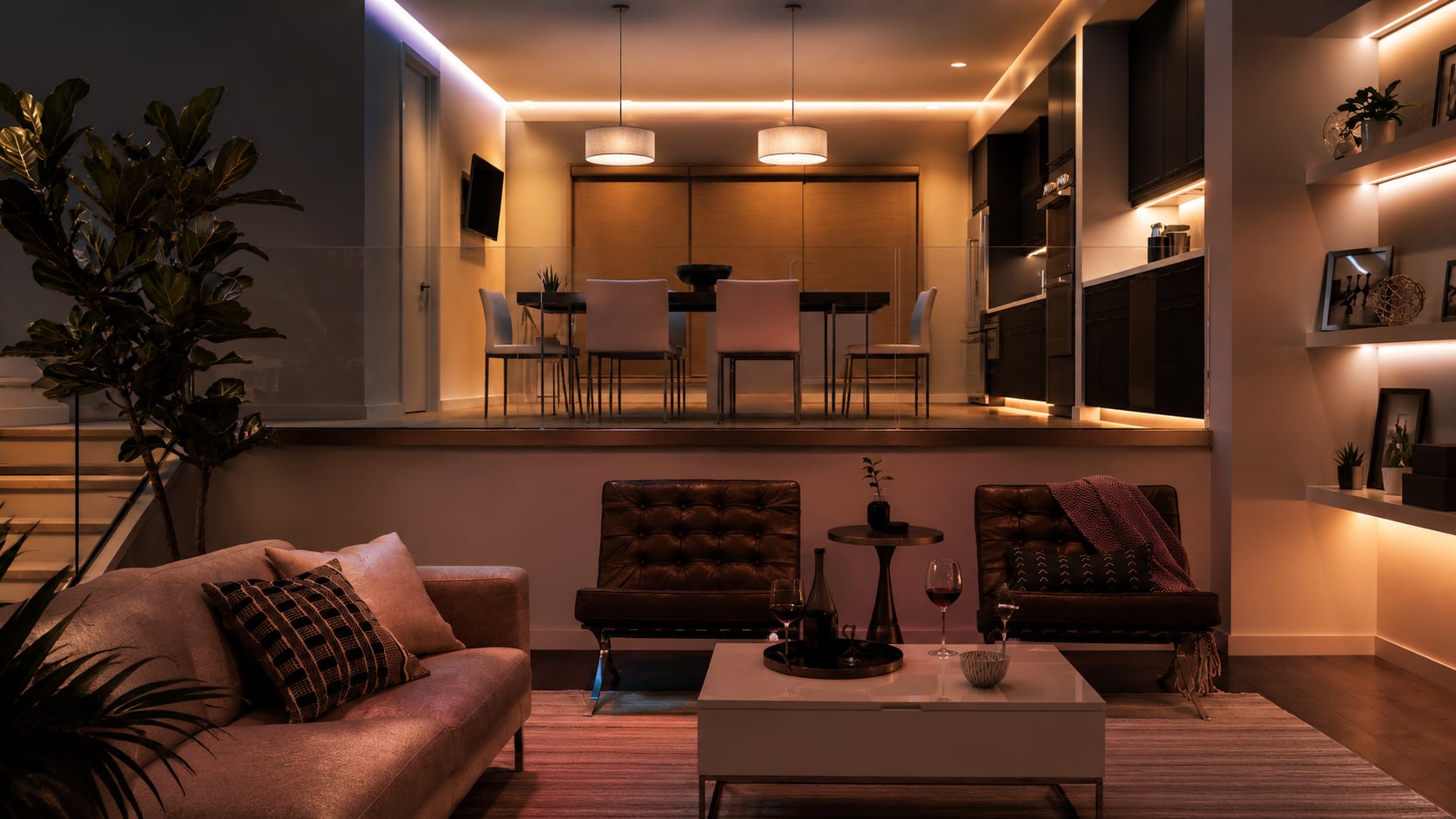
Why Light Decides How Your Day Feels
Have you ever wondered why a Sunday in the kitchen feels different than a Sunday at a friend's house, even though nothing else changed? Your body reads light. The cool, blue-rich light of morning suppresses melatonin and lifts your focus. The warm amber of evening tells the brain to start the wind-down. Standard LEDs hold a single color temperature all day — and that single note quietly disrupts the cycle, especially during a DFW summer when you live indoors to escape the heat. Circadian lighting fixes it. The fixtures shift their color temperature and intensity through the day, mirroring the sun from dawn to dusk.
We design these systems with Ketra full-spectrum fixtures, Savant tunable white drivers, and USAI color-selectable downlights — all programmed to your geography and your schedule. The lighting energizes you in the morning, eases the transition into the evening, and supports the deep, restorative sleep your week was missing.
The Science, Briefly
Circadian lighting works by modulating the melanopic content of the light — the slice of the visible spectrum that activates the photosensitive retinal ganglion cells governing your circadian clock. A standard warm-white LED at 2700K still carries enough blue spectral energy to partially suppress melatonin in the evening, which is why dimming a fixed-temperature fixture is not enough.
Ketra fixtures blend multiple LED emitters to produce a spectrum that travels from a melanopic-rich 6500K at breakfast to a melanopic-depleted 1800K candlelight after dinner. USAI and Savant tunable white systems blend warm and cool LED arrays for a 2200K-to-5000K range. Both produce measurably different biological impact than fixed-temperature lighting — and both feel measurably different to live with.
A Day Programmed Around You
We program circadian schedules room by room, around how and when you actually use the space. Kitchens and home offices receive strong, cool light during work hours, then warm into the evening for cooking and dining. Bedrooms start warm at sunrise, lift briefly during the morning routine, and slip back into deep amber two hours before your usual bedtime. Bathrooms used for nighttime visits hold a barely perceptible warm glow — enough to navigate, never enough to wake you up.
Different family schedules get different curves. The teenager who rises at seven sees one light progression. The parent who wakes at five sees another. All of it lives inside the Savant lighting platform and adjusts on its own for daylight saving time and the seasonal sunrise. Engineered around your day.
The Real-Life Payoff
Clients who switch to circadian lighting report falling asleep faster, waking sharper, and losing the afternoon slump. The outcomes are backed by peer-reviewed work from the Lighting Research Center and the WELL Building Standard, which now treats circadian lighting as a core health feature in residential and commercial design.
We pair circadian lighting with motorized shading to maximize natural daylight during the day and ease artificial blue light out of the evening. When the shades close at sunset, the lighting compensates with output at the right warm color temperature — visual comfort without circadian disruption. Your home turns into a wellness asset that supports the health of everyone living inside it.
The Questions People Actually Ask.
Is circadian lighting only for people with sleep problems?
No. Everyone has a circadian clock that answers to light. Properly tuned lighting helps anyone who lives indoors much of the day — which, in a DFW summer, is most of us. Better energy, mood, and sleep show up for clients with no preexisting issues at all.
Can circadian lighting be added to an existing home?
Yes. Savant tunable white drivers can replace standard drivers in many existing housings, and Ketra fixtures arrive as retrofit modules. The key requirement is a compatible Savant Lighting processor to handle the color temperature scheduling.
Does circadian lighting look noticeably different from standard lighting?
During the day, it looks much like a conventional cool-white LED. The visible difference shows up after sunset, when fixtures shift to a deep, warm tone — distinctly amber against the fixed 2700K of a standard LED. Most clients fall in love with the evening warmth the moment they live in it.
How does circadian lighting interact with natural daylight from windows?
Daylight sensors and shade position data steer artificial light output. On bright days, the system pulls back and lets the sun lead. On overcast days or in interior rooms with no windows, output rises to give your body the melanopic stimulus it needs.
What is the cost difference between circadian and standard LED lighting?
Tunable white fixtures usually run 40 to 80 percent more than fixed-temperature equivalents. Ketra full-spectrum fixtures sit higher and deliver superior color rendering. Most clients put circadian fixtures in the primary living spaces and use standard LEDs in closets, storage, and utility rooms.