
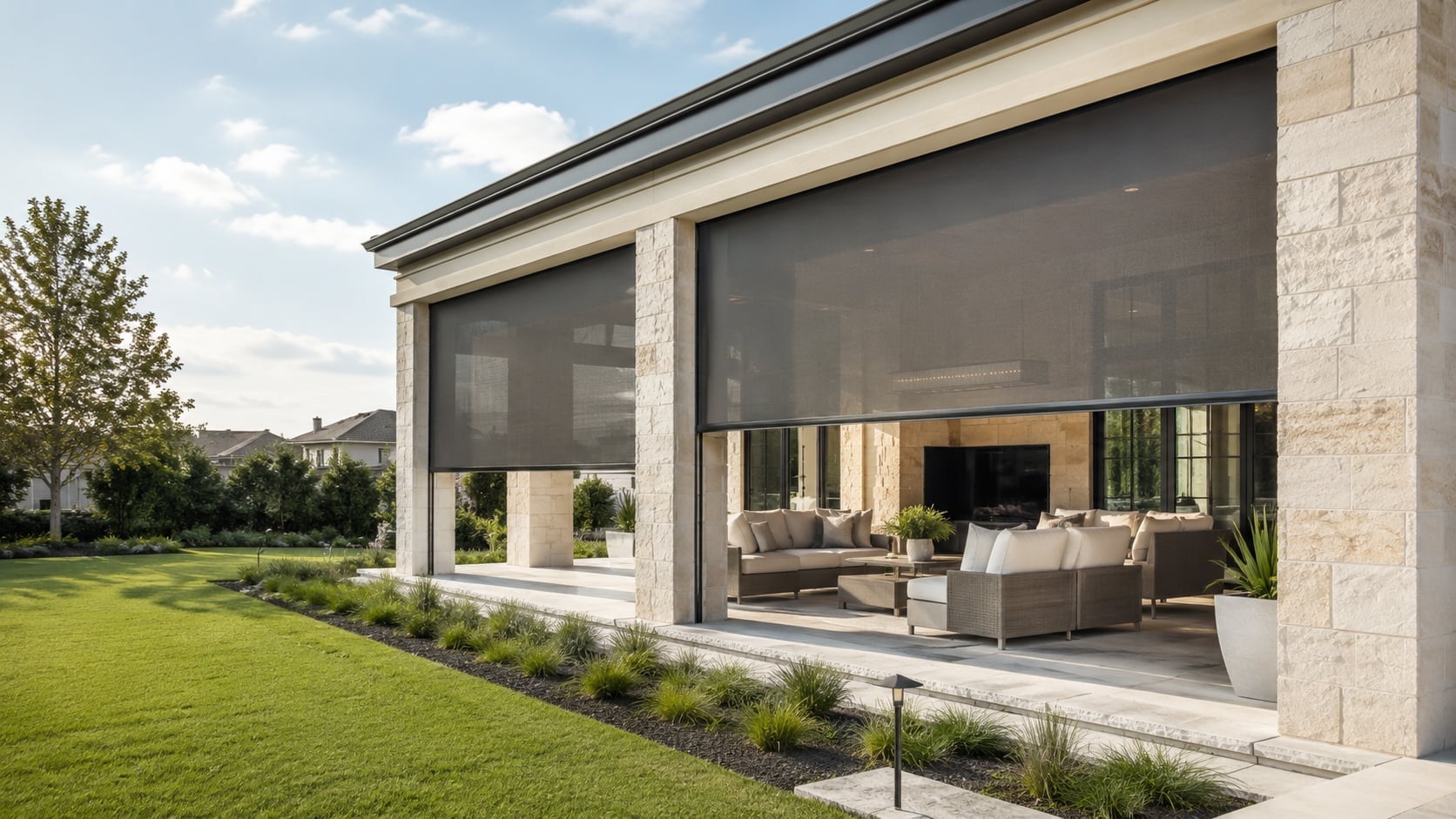
Extend Your Outdoor Season in the DFW Climate
Imagine the patio on a Friday in late June. A 102-degree afternoon eases into a 92-degree evening. The screens drop on a single press, the western sun turns to dappled gold, the mosquitoes lose interest, and the seven of you pour wine and stay until eleven. That is what an exterior motorized screen actually buys you. We install retractable systems from Crown Shade Company and Future Automation that fall on a button and disappear back into the housing the moment you are done with them. In DFW, where summer and mosquito season both run far too long, screens are the difference between a patio you walk past and a patio you live on.
Fixed screen enclosures change the look of a house and trap you in the same view all year. Motorized screens preserve the open-air feel when retracted, the cassette tucked at the roofline and finished to disappear into the trim. Drop them, and side channels seal the fabric edges so the wind cannot billow it. The system holds in gusts up to 45 mph depending on the line.
Screen Types and Fabric Options
Solar screens use dense mesh, openness factors from one to ten percent, and they cut solar heat gain by up to 90 percent while keeping varying degrees of view. Three percent openness blocks the harsh afternoon light and still lets you watch the kids in the pool. One percent gives you near-total blocking and privacy on a west-facing exposure. Both are engineered to live in the Texas sun for ten years or more without losing their fight.
Insect screens use a finer mesh that closes the door on mosquitoes, gnats, and the small biting things that find DFW so welcoming from spring through fall. A bug-free dinner outside, no citronella required. Wind and rain screens use heavier, less porous fabric that handles gusts and a passing shower, which extends your usable season into the cooler months. Some installations layer solar and insect on the same opening with two independent motors, so the right fabric drops at the right hour.
Installation and Control Integration
Where the housing lives depends on the structure. Covered patios with a solid roof get recessed cassettes, flush with the beam or soffit, invisible when retracted. Pergolas and open-top structures get surface-mounted housings in powder-coated aluminum matched to the structure. Side channels anchor to columns and posts and seal the fabric so it never fights the wind.
Every screen we install talks to your home automation. A wind sensor pulls the fabric back when gusts cross a threshold, a sun sensor drops it when the afternoon light starts cooking the patio, and a 3 PM schedule covers the west side every day without you ever asking. Manual override always sits in the keypad, the app, and your voice when you want to take the wheel.
Durability in North Texas Conditions
We spec for the Texas climate, not the catalog. Motors carry IP44 or higher ingress ratings. Fabric is solution-dyed so the color lives in the fiber itself, not painted on. Side channels are extruded aluminum, so they do not warp or corrode. Spring hail is the real wild card, and the system can be programmed to retract on a weather API alert before the storm reaches your zip code.
Annual maintenance is light. Clear the channels of debris, wipe the fabric with mild soap and water, lubricate the retraction mechanism. Our service plans cover all of that and put you at the front of the line if a storm ever does its worst.
The Questions People Actually Ask.
How do exterior screens handle strong Texas winds?
Side channels hold the fabric taut and stop billowing in winds up to 45 mph. A wind sensor automatically retracts the screens when sustained gusts cross the rated threshold, about a thirty-second pull, no input from you.
Can motorized screens fully enclose an open patio?
Yes. We install screens on every open side of a patio or pergola, so the space becomes a true room when deployed. Each side runs independently, so you can shut down the western sun and leave the north open for the breeze.
Do exterior screens reduce energy costs?
Screens on the sun-exposed sides of rooms with adjacent glass cut interior heat gain, which lowers HVAC runtime. The patio itself drops ten to fifteen degrees of surface temperature under cover, which makes any outdoor cooling, misters or evaporative units, work less hard.
Are the screens visible when retracted?
When fully up, the fabric rolls into a slim cassette at the roofline. Recessed installs are nearly invisible. Surface-mounted housings present a clean rectangular profile that matches the structure. Nothing fabric or mechanical hangs into the seating area.
How long do exterior screen fabrics last in the DFW sun?
Solution-dyed solar fabrics carry expected lifespans of ten to fifteen years with light maintenance. UV is the real aging factor, and the better fabrics with stronger UV stabilizers hold their color and tensile strength longer. Replacement is a straightforward service call when the day eventually comes.