The Network Every Highland Park Smart Home Depends On
Every smart system in a Highland Park estate — automation, lighting, audio, security, surveillance — leans on a network that has to never fail. And yet many of the area's loveliest homes still rely on consumer mesh routers that drop, bottleneck, and leave outdoor areas and guest houses in the cold. The dense construction Highland Park is famous for makes the problem worse — plaster-over-lath walls, stone exteriors, multi-story layouts, and metal lath between floors all eat WiFi for breakfast. We replace consumer kit with enterprise-grade access points, managed switches, and segmented architecture that delivers full coverage and the kind of reliability you stop having to think about.
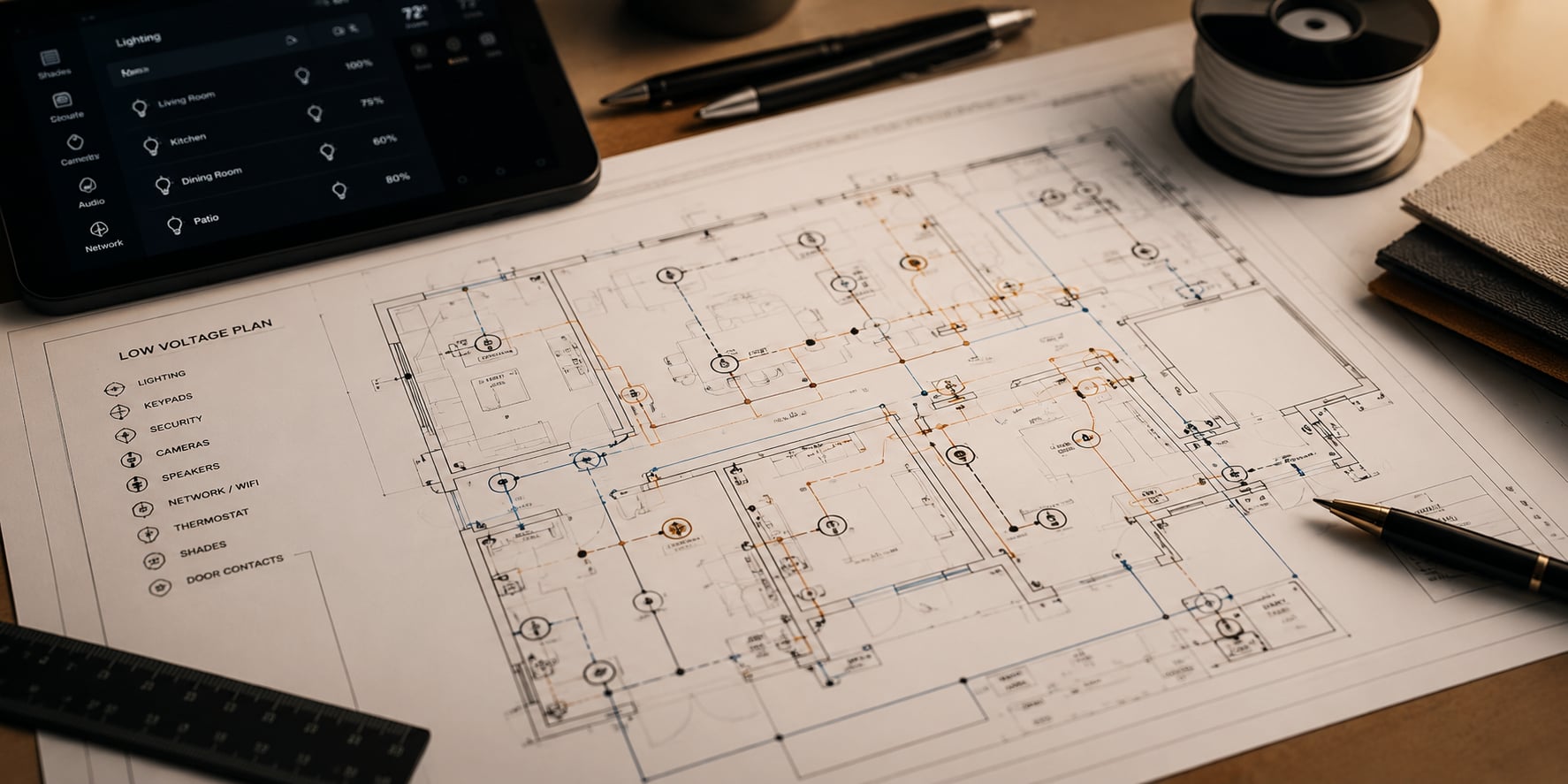
For new construction in Preston Hollow, we specify structured wiring during the architectural phase — Cat6A to every room, fiber backbones between floors and structures, dedicated conduit for the future. For existing Highland Park homes, we retrofit through attics, conduit, and hidden pathways to reach every TV, every office, every access point. Beyond raw coverage, we segment the network with VLANs that keep IoT devices away from your personal computers, guest networks that hand out internet without revealing private systems, and firewall policy that protects your cameras and your automation from anyone who has no business near them.
The Frustrations We Hear Most
- WiFi dead zones in master bedrooms, kitchens, and outdoor patios where the plaster and stone simply will not let the signal through
- A consumer mesh that demands a reboot every other week and drops calls at the worst moments
- No wired Ethernet at the TVs, the home office, the gaming setup
- IoT, personal devices, and security cameras all sharing one flat network with nothing to keep them apart
- A guest house, a pool house, or a garage with no real connection to the main residence
How We Do It in Park Cities
A Real Survey — We perform a heat-map analysis of the property with professional tools, finding the dead zones, the interference, the materials that are eating your signal.
Designing the Network — A custom topology — access point placement, switch locations, VLAN segmentation, equipment rack specs. Wired and wireless coverage designed for every room and every outdoor zone.
Cabling and Infrastructure — Cat6A and fiber routed through attics, conduit, and wall cavities to every access point, every TV, every office. In plaster homes we minimize wall openings by using existing chases and attic routes.
The Equipment Goes In — enterprise-grade access points mounted at the ceiling positions the survey called for. Managed switches, routers, and firewalls in a clean, organized rack with proper ventilation and power protection.
Configuration and Security — VLANs separate IoT, personal, guest, and AV traffic. Firewall rules guard the cameras and the automation. Guest WiFi gives visitors internet without ever showing them the house.
Testing and Documentation — We test speed and coverage in every room and every outdoor zone, document the topology, and hand your household the credentials and the number to call.
Who We Help in Park Cities
- You hit dead zones in the master, the basement, the backyard — and you are tired of restarting the router
- You work from home and your livelihood depends on a video call that does not stutter
- You run a smart home and you need the automation, the cameras, and the streaming devices to never blink
- You have 40 or more connected things competing for bandwidth across multiple floors and buildings
- You are building new in Preston Hollow and you want the wiring decided at the blueprint stage, not after
The Questions People Actually Ask.
Why does WiFi perform so poorly in older Highland Park homes?
Plaster-over-lath walls hold metal mesh that acts like a partial Faraday cage and absorbs WiFi before it can cross the room. Stone exteriors, multiple floors, and dense hardwood framing only make it worse. Enterprise access points placed strategically on each floor and in each wing handle these obstacles in a way no consumer mesh ever will.
What is the difference between consumer mesh WiFi and enterprise WiFi?
Consumer mesh systems backhaul wirelessly between nodes, and every hop costs bandwidth. Enterprise systems like enterprise-grade use wired Cat6A to every access point — full bandwidth at every location, with centralized management, band steering, and client load balancing that mesh systems do not have.
Can you run Cat6A wiring through a finished Highland Park home?
Yes. We route through attics, under floors where we can, and through existing conduit and chase walls. Our technicians know plaster construction and use techniques that keep wall openings small and patches invisible after paint.
Do you provide ongoing network management and monitoring?
Yes. We offer remote monitoring that flags equipment failures, unusual traffic, and connectivity issues before you notice them. Firmware updates, security patches, and configuration changes happen remotely whenever they can.
How many access points does a typical Highland Park estate need?
A 6,000 to 10,000 square foot Highland Park home with plaster construction usually wants 5 to 8 access points for full indoor and outdoor coverage. Larger Preston Hollow estates with guest houses and broad outdoor areas can ask for 10 to 15.