Why Consumer Wi-Fi Gives Up in a Real Home
A mesh kit from a big-box shelf was made for a 2,000-square-foot apartment with fifteen devices. Ask it to carry a 10,000-square-foot Southlake estate — stone veneer, a detached guest house, a pool cabana, and 120 connected things including Savant controllers, Savant processors, Steinway Lyngdorf amplifiers, security cameras, motorized shades, five TVs, and a family of four with three devices each — and it folds within months. Dropped calls. A buffering stream. A thermostat that misses a command because the radio walked off. The house is fine. The network is undersized.
We deploy enterprise-grade enterprise access points built for high-density rooms. enterprise-grade BeamFlex+ adaptive antenna technology shapes the signal toward each device rather than spraying it in a static pattern, which reaches further through stone, stucco, and the layered walls of a real home. Two hundred devices at once, no degradation. Three hundred and beyond on the largest DFW estates.
Site Survey and RF Design
Every install starts with a professional radio-frequency site survey. We walk the property with spectrum analysis tools, mapping how the signal moves through every wall material, floor, and outdoor structure. Texas houses have personality — stacked stone fireplaces eat 5 GHz alive, steel-framed media rooms become small Faraday cages, and outdoor coverage has to reach two hundred feet across a one-acre lot in Vaquero or Montserrat.
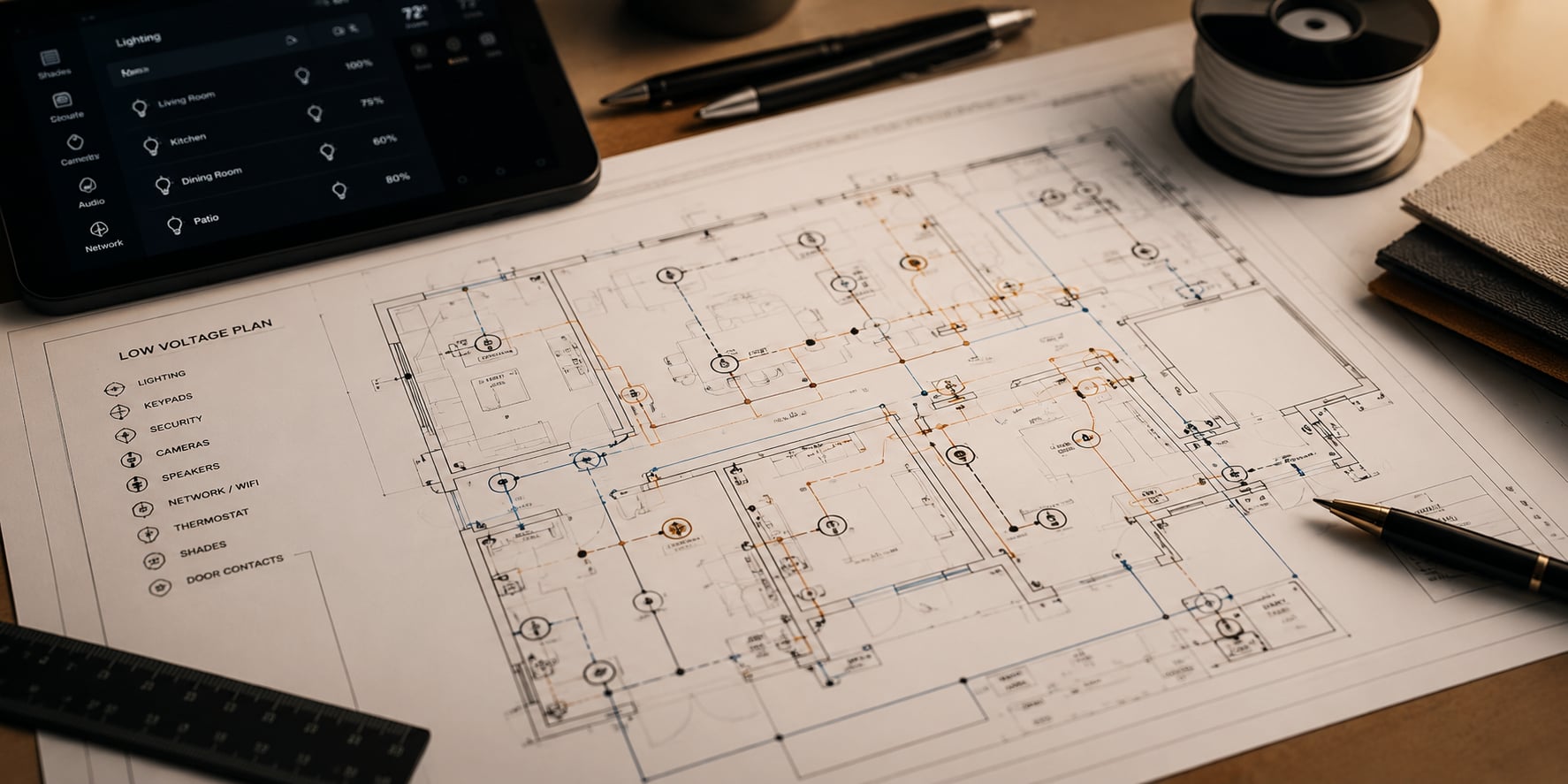
From the survey, we draw a heat map — access point placements, channel assignments, predicted signal strength in every room and every patio chair. Six to twelve access points cover most 10,000-square-foot homes. We pick the spots where they disappear into ceilings, walls, or attic mounts with directional antennas serving rooms below without a single visible piece of hardware on the finished surface.
Architecture and VLAN Segmentation
Enterprise Wi-Fi is only as honest as the wired backbone behind it. Every access point gets a dedicated Cat6A home run to a managed PoE+ switch in the network rack — consistent throughput, consistent power. We segment the network into VLANs: one virtual network for IoT, another for personal devices, a third for guests, a fourth for security cameras. A compromised smart plug never reaches your laptop. Broadcast traffic stays small. Bandwidth gets allocated where it earns its place.
For enterprise-grade, we use the Unleashed controller built into the master AP for properties up to twenty-five access points — no separate hardware controller, no extra rack unit. enterprise-grade networks live in the OvrC cloud platform so our team can monitor and manage from anywhere. Both quietly handle automatic channel optimization, band steering from 2.4 GHz to 5 GHz, and 802.11r fast roaming so a FaceTime call survives the walk from the kitchen to the pool deck without a flicker.
Outdoor and the Strange Edges
DFW outdoor living has its own coverage needs. We deploy weatherproof access points rated IP67 for Texas heat, thunderstorms, and dust. enterprise-grade T350 and enterprise-grade AN-820 outdoor models tuck under eaves or inside landscape enclosures, covering pools, patios, outdoor kitchens, sport courts, and motor courts. For detached structures past three hundred feet, we install a point-to-point wireless bridge on a dedicated 60 GHz backhaul — separate radio, no interference with the home network.
The strange edges get their own answers. A wine cellar behind glass walls gets a small in-wall AP. An elevator cab in a metal enclosure gets a tiny AP inside the cab on a trailing Cat6A. We find these during the survey, name them, and solve each one before commissioning. No one ever finds a dead zone after move-in.
The Questions People Actually Ask.
How many access points does a typical DFW home need?
A 5,000-square-foot home usually wants four to six. A 10,000-square-foot property needs eight to twelve. Homes over 15,000 square feet, or with detached structures, heavy stone construction, or extensive outdoor areas, may want fifteen or more. The exact count comes out of the RF site survey.
What is the difference between enterprise-grade?
enterprise-grade is a Tier 1 enterprise brand with patented adaptive antenna technology — best for large estates and difficult RF environments. enterprise-grade is a custom-integration brand managed through OvrC, with strong performance at a lower price. We tend to recommend enterprise-grade over 8,000 square feet and enterprise-grade for smaller homes.
Will I still have a single network name for the whole house?
Yes. Every access point broadcasts the same SSID. Your devices connect to the strongest AP as you move, and 802.11r fast roaming hands off in milliseconds. You will not feel it during a video call or a song.
Can you provide coverage to a detached guest house or pool cabana?
Yes. For structures within three hundred feet with line-of-sight, outdoor access points carry the signal. For longer distances or obstructed paths, a point-to-point wireless bridge delivers a dedicated backhaul to the detached structure, where a local AP gives the room its own clean Wi-Fi.
Do you provide ongoing network monitoring?
Yes. Our managed network service includes 24/7 remote monitoring, firmware updates, performance tuning, and priority support. We see channel congestion, failing APs, and bandwidth anomalies before you ever notice them — and resolve most of it before the next song starts.