Why Wiring Is the Quiet Foundation
Every smart-home technology rides on cable. Even the wireless ones — they all end at a wired access point, controller, or switch. A Savant system streaming 4K to six rooms wants 150 Mbps a stream and never wavers. Savant Lighting talks to keypads and shades over dedicated low-voltage wire. Steinway Lyngdorf amplifiers expect shielded Cat6 or fiber. Cameras send 4K to the NVR over PoE. Without an honest infrastructure underneath all of it, systems fight for bandwidth, develop latency, and fail in maddening, intermittent ways.
We design every wiring plan with a twenty-year horizon. Cat6A is our floor — rated for 10 Gbps at one hundred meters — even though most current devices live at 1 Gbps. We pull spare conduit to every major room and pathway so a future cable goes in without anyone opening a wall. And we label, test, and certify every single run to TIA-568, so you walk away with documentation any technician will read fluently decades from now.
New Construction Pre-Wire
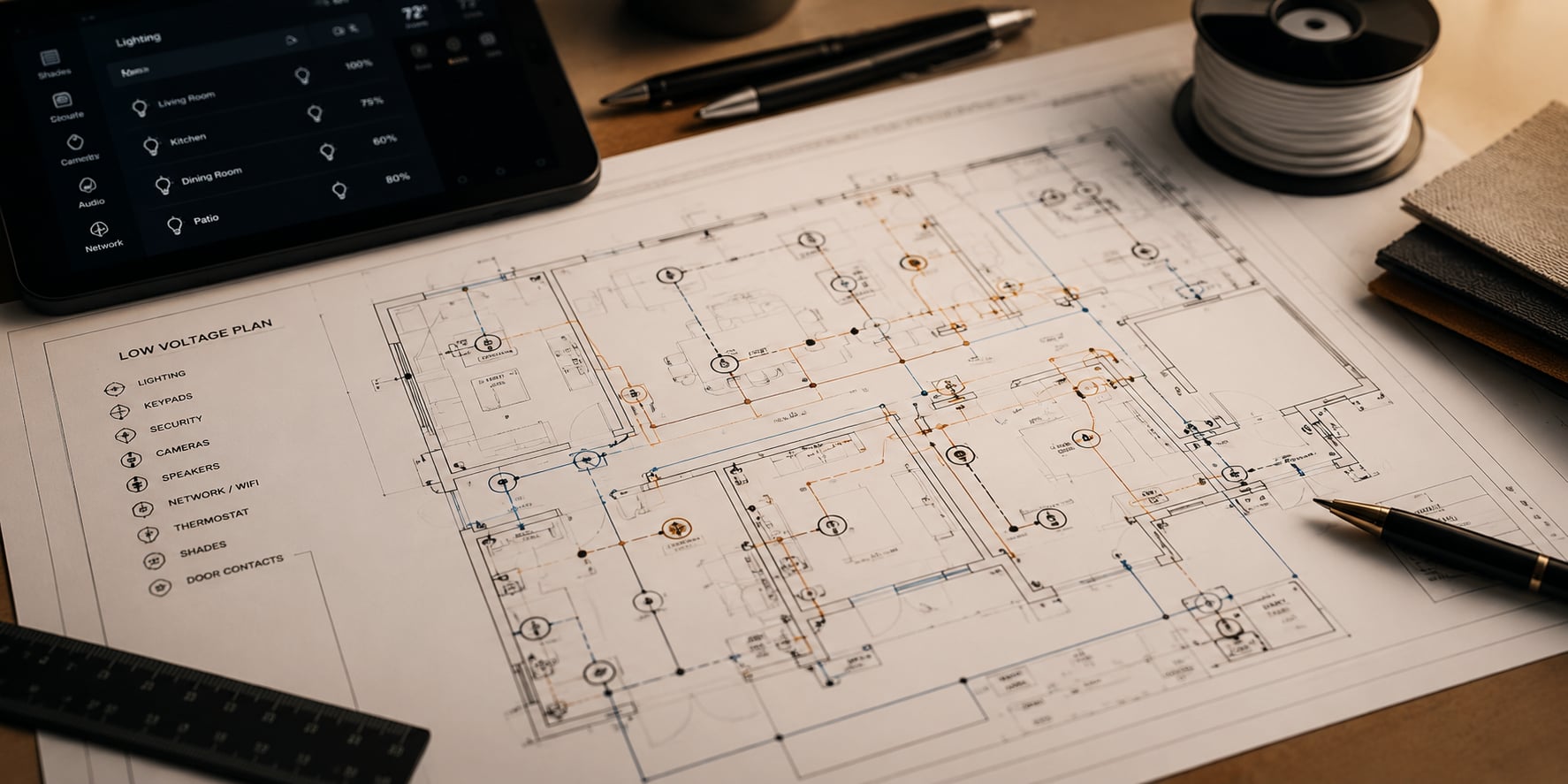
For new builds across Frisco, Prosper, Celina, and the wider Metroplex, we engage during architectural design — ideally before framing. We read the floor plan and produce a wiring diagram that names every run: Cat6A for network and PoE, 16/4 speaker wire for in-ceiling Steinway Lyngdorf or Savant, 14/2 for shade motors, RG6 for legacy coax, and fiber optic for the long HDMI distances over fifty feet. Every cable returns to a central network closet or equipment room.
During rough-in, our low-voltage techs work alongside the electrical contractor — pulling cables through open walls, securing them with proper bend radius, fire-rating the floor penetrations, holding the NEC twelve-inch separation from high-voltage. Ten-foot service loops at both ends of every cable, because the future re-termination is a question of when, not if. Three to five days for a 7,000-square-foot home, 120 to 200 individual runs.
Retrofit and Renovation
Adding structured wiring to an existing home — common in Highland Park, University Park, and the older estate streets of Preston Hollow — is a creativity exercise. We use what the house already gives us: attic access, the rare crawl space, interior wall chases, plenum spaces above drop ceilings. Where there is no path, we make conduit through closets, utility spaces, and along baseboards with paintable covers that disappear into the millwork.
Slab-on-grade homes ask the most. We route overhead through the attic to interior wall top plates, dropping cables down to the outlet locations. Brick veneer walls get routed around through interior partitions instead of through. Every retrofit gets a survey before any drywall meets a knife — pathways identified, structural members and HVAC ducts respected, drywall patches minimized. The goal is the same on every job: zero visible evidence the house ever changed.
Testing, Certification, Documentation
Every cable is tested with a Fluke DSX-5000 cable analyzer and certified to Cat6A channel performance. Attenuation, near-end crosstalk, return loss, alien crosstalk — the four numbers that decide whether the cable will hold 10 Gbps for its full length. Anything that fails certification is re-terminated or replaced before we close a wall. You receive a bound report with the test for every run.
Documentation lives in two places. A floor-plan overlay showing the cable routes. A patch panel diagram with every port assignment. A digital database of every cable's origin, destination, type, length, and test result — in your home's technology binder and in our cloud client portal, accessible to you, your property manager, and any future integrator who walks through the door. The difference between a two-hour service call and a two-day mystery.
The Questions People Actually Ask.
Why Cat6A instead of Cat6 or Cat5e?
Cat6A holds 10 Gbps at one hundred meters with improved shielding against crosstalk. Most devices today are happy at 1 Gbps, but the next wave of access points, media servers, and cameras will want 2.5 to 10 Gbps. Cat6A costs fifteen to twenty percent more than Cat6 — and gives you another decade of useful life.
How many cable runs does a typical luxury home need?
A 5,000-square-foot home usually needs eighty to a hundred and twenty runs. A 10,000-square-foot estate, a hundred and fifty to two hundred and fifty. That includes network drops, speaker wiring, shade motors, cameras, HDMI and fiber, intercom, and spare pulls. We work the exact number from your technology plan.
Can you add wiring to my existing home without destroying walls?
In most cases, yes. Attic routing, interior wall chases, and conduit pathways carry most of the work without opening drywall. Slab-on-grade construction is the toughest, but we have completed hundreds of retrofits in older DFW homes with almost no visible impact. A pre-installation survey writes the strategy before any tool comes out.
Do you install fiber optic cable?
Yes. Single-mode and multi-mode fiber for long HDMI runs over fifty feet, inter-building connections, and future-proofing. Fiber ignores electromagnetic interference and carries virtually unlimited bandwidth over distance. We terminate with LC or SC connectors and test with an optical loss test set.
What happens if a cable fails years later?
Every run has a spare pull string in the conduit or wall cavity, so a replacement gets pulled without opening the wall. The Fluke certification report is your baseline — if a cable starts behaving oddly, we re-test and locate the problem inside the run. Most failures live at the termination points, and most are re-terminated and finished in a single visit.