
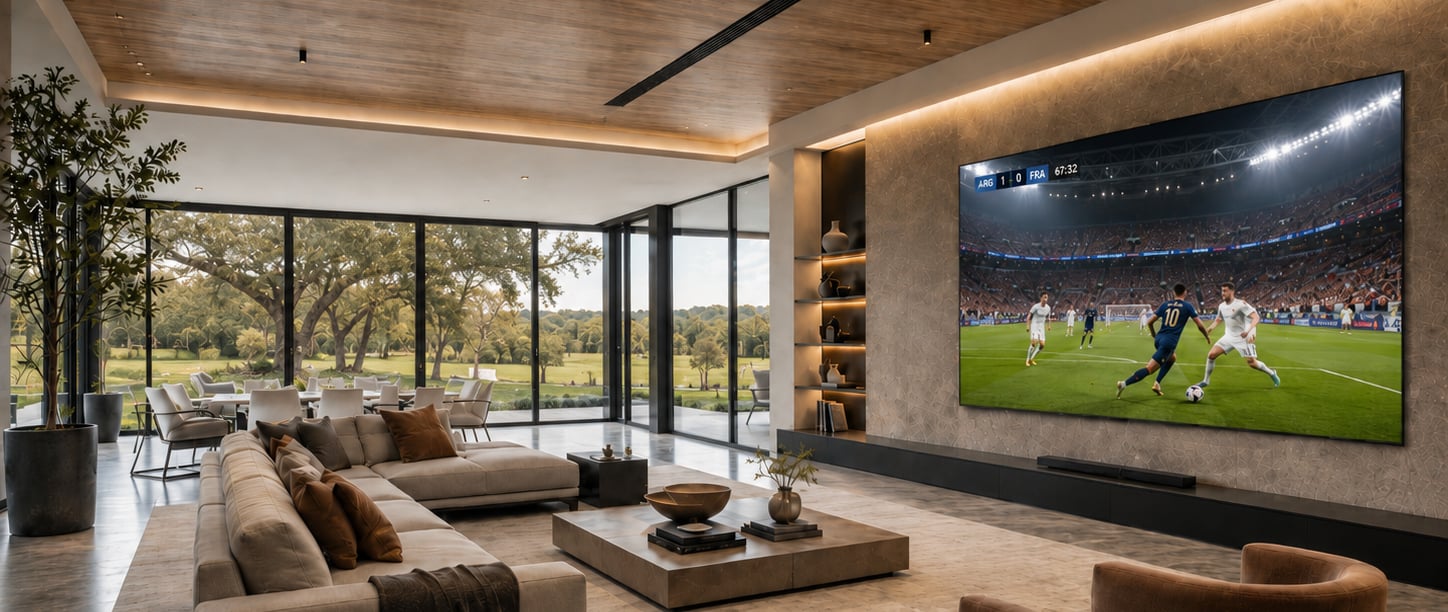
Why LED Quietly Replaced the Screen
A great room in Clearfork. Twenty-four-foot ceilings. A west-facing wall of glass that fills the room with afternoon sun. The brief was a screen visible from the kitchen, the dining table, and the conversation pit, capable of carrying a Cowboys game on Sunday afternoon with the shades up. No projector throws enough light to win that room. A 110-inch television feels small at the seating distances. The answer was a 16-foot direct-view LED wall — Megapixel HELIOS modules, 1.5-millimeter pixel pitch, 1,200 nits of brightness, perfect blacks even with the sun coming through the glass.
Direct-view LED is not new. It has powered NBA jumbotrons and Times Square for years. What is new is the pixel pitch — modules now fine enough at sub-2mm spacing to deliver a perfect 4K or 8K image at residential viewing distances. We design and install these walls for the rooms where a projector or a television simply will not do.
How a Wall Comes Together
Megapixel HELIOS is the platform we reach for most often in residential — modular cabinets that tile together with no visible seam, factory-matched in batches so color and brightness hold uniformly across the entire wall. Pixel pitches from 0.9mm to 1.9mm depending on viewing distance. Front-serviceable design so a single module can be replaced in minutes without dismantling the wall. The processor that drives it — typically a Megapixel HELIOS LED controller or a Brompton Tessera SX40 — handles 4K-120 or 8K-60 input and renders it across the LED surface with frame-perfect color accuracy.
For signature spaces — a private cinema with a 24-foot screen, a great-room feature wall, a wine room with an art-mode display — we specify ROE Visual Black Pearl for the deepest blacks or Samsung The Wall for clients who want a turnkey factory-supported product. Each project starts with a viewing-distance calculation that determines the right pixel pitch, then moves to structural engineering for the mounting framework and power distribution.
Installation and the Engineering Behind It
An LED wall is a building project. We engage during architectural design — the wall framework hangs from structural steel or reinforced framing, the power and signal infrastructure routes through dedicated conduit, the heat output (real, on a wall of this size) ventilates into a dedicated return or a small mini-split. For a typical 12-foot residential wall, total power draw lands around 4 to 8 kilowatts at peak brightness, with dedicated 30-amp circuits and Torus power conditioning to keep the signal clean.
Calibration runs in two passes. The first aligns brightness and color uniformity across every module using factory data and on-site colorimeter measurement. The second tunes the processor for HDR tone mapping, gamma curves, and the specific room's ambient lighting conditions. The result is a wall that holds a perfectly even image from any seat in the room — at full brightness through Sunday afternoon, dimmed to cinema reference for a Saturday night.
The Questions People Actually Ask.
How is an LED wall different from a very large television?
No size limit. No visible seams between modules. No backlight bloom or local-dimming halos. Perfect blacks because each pixel emits its own light. Brightness that holds 1,000 to 2,000 nits sustained — three to five times what most premium televisions manage. The trade is cost and installation complexity, both of which are real.
What viewing distance is needed for a 1.5mm pixel-pitch wall?
About six to ten feet for the pixels to fully resolve to the human eye. For closer viewing distances, we specify 0.9mm to 1.2mm pitch. For great rooms with seating fifteen feet or more away, 1.9mm pitch delivers an extraordinary image at a more accessible price. We model your room's geometry before recommending.
How long does an LED wall installation take?
Four to eight weeks from order to commissioning, depending on the size of the wall and the construction status of the room. Lead times on the modules themselves run four to twelve weeks. The actual on-site assembly takes a week or two. Calibration and integration with Savant follow.
Will the wall fade or develop dead pixels over time?
LED modules carry a rated 100,000-hour life to half-brightness — over thirty years of regular evening use. Dead pixels are rare and individually field-replaceable in minutes. We provide ongoing service contracts that include spare modules held at our warehouse for any signature install across DFW.