The Room Matters More Than the Equipment
You can spend $50,000 on speakers and processors, and an untreated room will undo all of it. Flutter echo between parallel walls. Comb filtering at the seat. Reverberation that smears the words on the screen. Bass that booms in one chair and disappears in the next. None of it is fixed by equalization. The room itself has to be tuned.
We treat acoustics as engineering, not decorating. Calibrated microphones. REW analysis software. A measurement of your specific room — its frequency response, its decay, the places where it fights you. Then a treatment plan written to those measurements, using the minimum material that solves the problem. The goal is a controlled room, not a dead one. Reverberation between 0.3 and 0.5 seconds. Even bass at every seat. Dialogue that lands.
Absorption, Diffusion, and Bass Control
Acoustic treatment uses three tools. Absorption panels turn sound energy into heat, calming reflections. Diffusion panels scatter sound in many directions, preserving energy without focused echoes. Bass traps absorb low-frequency energy that piles up in corners and along ceiling boundaries.
In a DFW theater, absorption typically lives at the first reflection points on side walls and ceiling — where the sound from the front speakers bounces and reaches you slightly delayed, smearing the direct sound. Diffusion goes on the rear wall to keep the room feeling alive without distinct echoes. Bass traps stand floor-to-ceiling in the front and rear corners, taming the modes that make the bass uneven. The exact mix and placement comes from the measurements, never from a generic recipe.
Isolating the Theater From the Rest of the House
Acoustic treatment is what happens inside the room. Soundproofing is what happens between rooms. Two completely different disciplines. A room can be treated to perfection and still leak bass into the bedroom upstairs if its walls, ceiling, floor, and doors do not block transmission.
For dedicated theaters in DFW homes, we design wall and ceiling assemblies targeting STC ratings of 55 to 65, which knocks the perceived sound in adjacent rooms down by 90 to 99 percent. Decoupled framing on resilient channel or isolation clips with hat channel. Double layers of 5/8-inch drywall with Green Glue between them. Sealed acoustical penetrations at outlets and HVAC. Solid-core doors with perimeter seals and automatic door bottoms. For rooms above living spaces, a floated floor assembly that keeps the bass from traveling through the structure. The result: a theater that lets you turn it up, while the rest of the house stays quiet.
Acoustic, and Beautiful
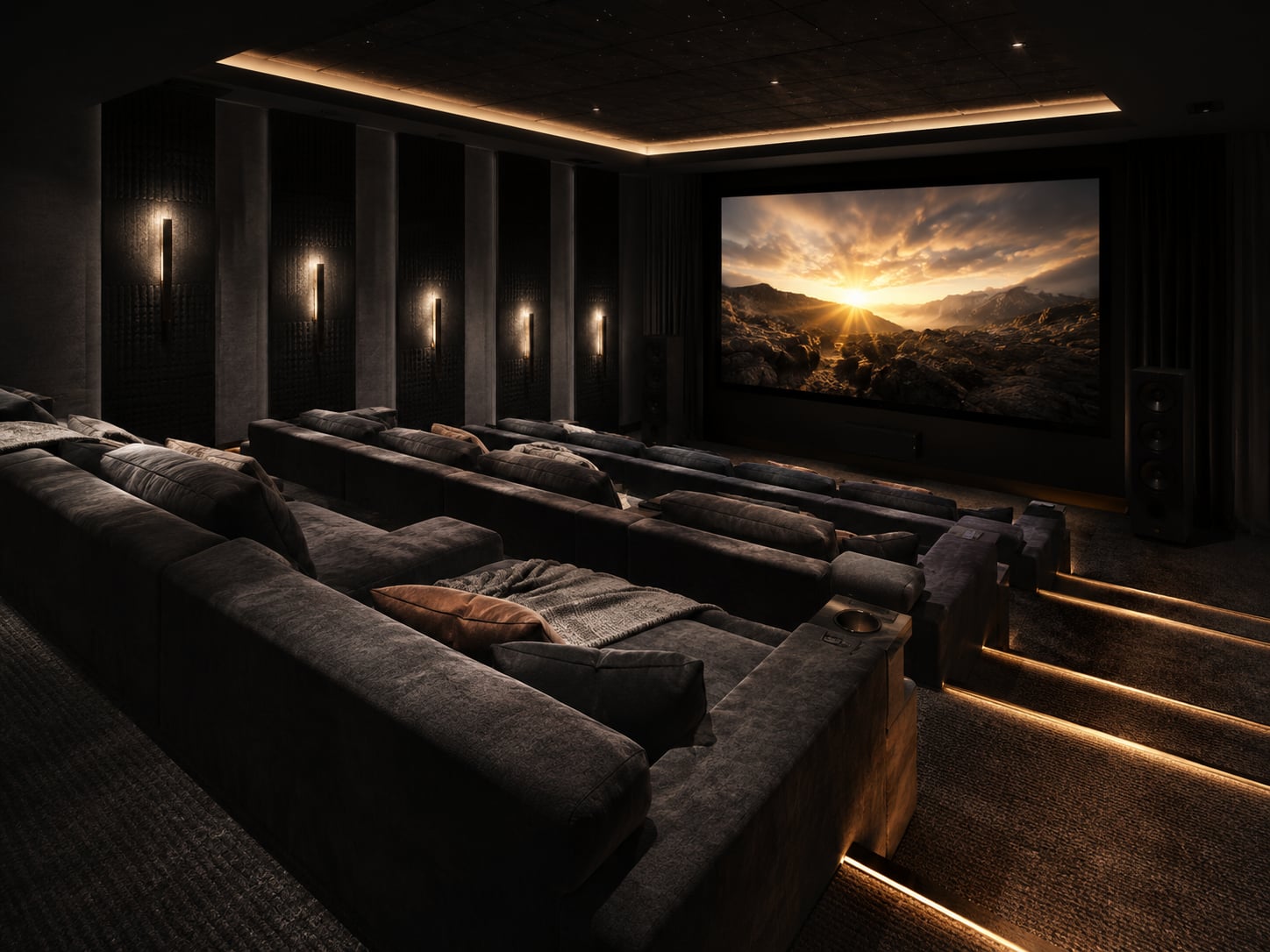
Acoustic panels do not have to look like the inside of a recording studio. Modern architectural products from Vicoustic, GIK Acoustics, and RPG arrive as fabric-wrapped panels, wood slat diffusers, and sculptural shapes that belong in a finished room. We choose fabric, color, and pattern to match your aesthetic — a classic cinema in dark cloth and concealed panels, or a modern room with exposed wood diffusers and accent lighting.
In many of the DFW theaters we build, the acoustic treatment vanishes entirely behind a stretched fabric wall system. The whole room is wrapped — absorption and diffusion live behind a single elegant surface. Optimal acoustics. None of the engineering visible. Exactly what discerning homeowners ask for.
The Questions People Actually Ask.
Can I add acoustic treatment to an existing room without major construction?
Yes. Surface-mounted absorption panels and freestanding bass traps can move into any room without construction. They mount to the walls and corners with no structural change. For deeper treatment or true soundproofing, some construction is required, but it stays inside the theater room itself.
What is the difference between acoustic treatment and soundproofing?
Acoustic treatment shapes how sound behaves inside the room — quieter echoes, calmer bass, clearer dialogue. Soundproofing keeps sound from passing through walls, ceilings, and floors into the rest of the house. A real theater needs both: treatment for the listening experience, isolation so the rest of the household stays peaceful.
Will acoustic treatment make my room sound dead or unnatural?
Not when it is designed properly. Over-treatment is the most common DIY mistake. We target a reverberation time of 0.3 to 0.5 seconds for cinema use — short enough for clear dialogue and precise surround, long enough to keep the natural sense of space. Strategic diffusion preserves the liveliness while fixing the problems.
How do you measure a room's acoustics before designing treatment?
A calibrated measurement microphone goes at the primary seat, and we use REW (Room EQ Wizard) to capture frequency response, impulse response, waterfall decay, and reverberation time. The measurements show exactly where the room misbehaves — bass modes, flutter echo, early reflection issues — and they shape the type, quantity, and placement of every panel that follows.